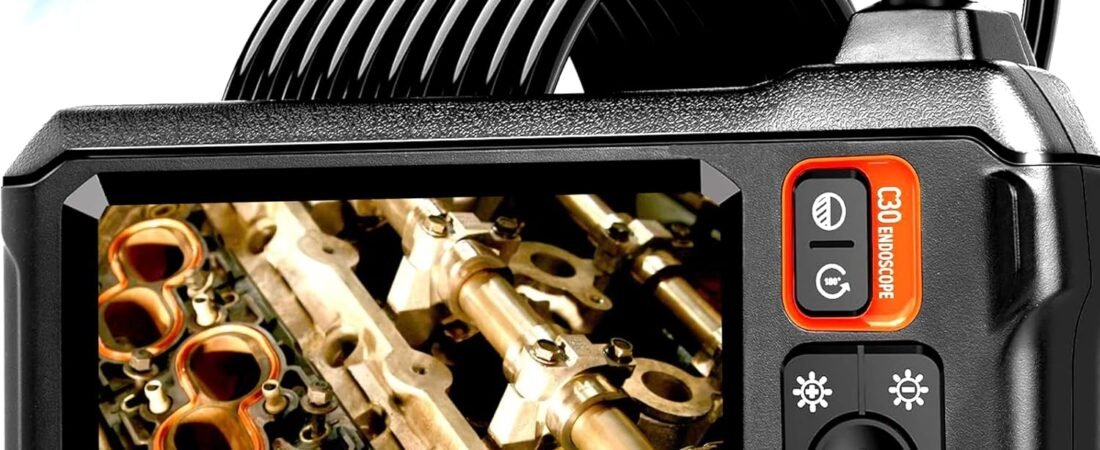
When something goes wrong in a narrow, enclosed, or difficult-to-reach space, a conventional flashlight often provides only part of the answer. You may be able to illuminate an opening, but seeing what is actually inside a pipe, engine compartment, appliance, wall cavity, or other restricted area can be much more difficult. This is where an inspection camera, often called an endoscope camera or borescope, can become a useful diagnostic tool.
The Daxiongmao Endoscope Camera with Light, 1080P HD Borescope is designed around this basic idea: place a small camera at the end of a flexible inspection cable, illuminate the surrounding area, and view the resulting image on a compatible display. Instead of relying entirely on guesswork or dismantling equipment, users can potentially inspect areas that would otherwise be hidden from direct view.
A borescope does not replace professional diagnostic equipment in every situation. Its usefulness depends on the size of the camera head, cable flexibility, lighting conditions, accessibility, and the type of problem being investigated. Nevertheless, inspection cameras can be valuable for routine maintenance, DIY projects, automotive work, household troubleshooting, and many other situations where visibility is limited.
This guide explains how a 1080P inspection camera works, the types of tasks it can support, what to consider before using one, and how it compares with other inspection approaches.
Understanding an Endoscope Camera
An endoscope camera is essentially a small video camera designed to look into spaces that are difficult to see with the naked eye.
The basic arrangement normally consists of several components:
- A miniature camera at the end of a probe
- A flexible cable or semi-rigid inspection shaft
- Integrated lighting around the camera
- A connection system for sending the image to a compatible device
- Controls or software for viewing and sometimes recording the inspection
The camera is inserted into an opening, while the person performing the inspection watches the image from the connected screen or device.
This approach can make a significant difference when physical access is limited. For example, inspecting the inside of a large machine may require removing panels if done manually. With a sufficiently compact inspection camera, it may be possible to examine the area through an existing opening first.
That does not necessarily eliminate the need for disassembly. Instead, the camera can provide an initial look that helps determine whether further work is necessary.
The Daxiongmao model is described as a 1080P HD borescope with lighting and a waterproof-oriented inspection design. These characteristics place it within the general category of compact visual inspection tools intended for areas where conventional cameras and direct viewing are inconvenient.
Key Features to Understand
1080P HD Inspection Video
The 1080P designation refers to a high-definition image format commonly associated with a resolution of approximately 1920 × 1080 pixels.
For inspection work, resolution matters because small details can influence what the user sees. Scratches, buildup, loose components, cracks, debris, corrosion, or other visible conditions may be easier to distinguish when the image contains sufficient detail.
However, resolution is only one part of image quality.
The final picture can also depend on lighting, lens quality, camera sensor performance, distance from the subject, movement of the probe, and the viewing environment. A 1080P camera can provide useful detail while still producing a less clear image in a dark, reflective, dusty, or extremely confined environment.
For that reason, it is better to think of 1080P as a useful image-resolution specification rather than a guarantee of professional inspection quality.
Built-In Lighting
The camera’s integrated lighting is particularly important because many inspection environments are naturally dark.
Inside a pipe, behind an appliance, under a vehicle dashboard, or inside a mechanical assembly, ambient room lighting may not reach the area being examined.
A built-in light allows the camera to illuminate the scene from the same direction as the lens.
Lighting is also one reason that inspection cameras can be more practical than simply placing a phone flashlight near an opening. The camera and light can travel together into the restricted space.
Users should still be aware that reflective surfaces can create glare. Highly polished metal, glass, wet surfaces, and other reflective materials may appear washed out when the light is directed straight toward them.
Adjusting the camera’s position or lighting level can sometimes make details easier to see.
Flexible Inspection Probe
A flexible probe allows the camera to reach around obstacles and into spaces that are not directly aligned with the opening.
This is particularly useful in automotive and household applications, where the area of interest may be behind another component.
Flexibility also makes storage and transportation easier than with some rigid inspection instruments.
At the same time, extremely flexible probes can sometimes be harder to position precisely. If the user needs the camera to remain pointed in a particular direction, the behavior of the cable becomes an important part of the inspection process.
A controlled, gradual movement generally produces a more useful image than rapidly pushing the camera forward.
Waterproof-Oriented Design
Inspection environments can sometimes involve moisture, condensation, or damp surfaces. A waterproof or water-resistant camera probe can therefore be useful for certain inspection tasks.
However, waterproofing should never be interpreted as permission to use the complete system underwater unless the manufacturer’s documentation specifically states that the entire system is suitable for that purpose.
There can be an important difference between a water-resistant camera head and the rest of the device.
Before exposing the equipment to liquids, users should verify the applicable protection rating and manufacturer instructions. The connector, control section, smartphone, or display may not have the same protection as the probe.
Compact Camera Head
The small camera head is one of the defining characteristics of an inspection camera.
The smaller the camera assembly, the more potential access points become available. But size should always be considered alongside the dimensions of the actual opening being inspected.
A camera that fits through an opening still needs enough clearance to move and turn. If the passage is extremely narrow or contains fragile components, forcing the probe inside could create damage.
How a 1080P Borescope Can Be Used
The usefulness of an inspection camera comes from the variety of places it can reach.
Rather than being limited to one specific profession, a tool in this category can support many different inspection situations.
Automotive Inspection
Vehicle maintenance is one of the most obvious applications for a borescope.
There are numerous locations inside and around a vehicle that are difficult to inspect directly. An inspection camera may help provide a visual check of areas such as:
- Tight engine-bay spaces
- Behind or underneath components
- Areas around hoses and wiring
- Difficult-to-reach mechanical spaces
- Interior cavities
- Drain channels
- Areas where debris may have accumulated
A borescope can be particularly useful during troubleshooting because it allows the user to look before deciding whether a component needs to be removed.
For example, if something has fallen into an inaccessible area, visual inspection may help establish where it is located.
However, vehicle components can become hot, and moving mechanical parts can present serious hazards. The engine should be turned off when appropriate, hot components should be allowed to cool, and the probe should be kept away from moving belts, fans, and other dangerous mechanisms.
Plumbing and Pipe Inspection
Small inspection cameras are also useful for visual checks inside accessible pipes and drains.
The camera may help identify visible debris, buildup, obstructions, standing water, or other conditions.
This can be particularly helpful when a drainage problem is suspected but the cause is not immediately visible.
However, a small consumer borescope should not automatically be treated as a replacement for professional drain inspection equipment. Long pipe runs, complex bends, heavy blockage, standing water, and poor visibility can all limit what a compact camera can accomplish.
The camera can provide visual information, but interpreting what that information means may still require plumbing knowledge.
Home Maintenance
Around the house, an inspection camera can be useful for checking spaces that are otherwise inconvenient to access.
Potential examples include:
- Behind appliances
- Under cabinets
- Inside accessible wall openings
- Around ventilation areas
- Behind furniture
- Inside larger equipment
- Under decks or structures
- Narrow storage spaces
One advantage is that the camera can help users investigate a problem without immediately removing panels or moving heavy objects.
For instance, if an object falls behind a large appliance, an inspection camera may help determine whether it is reachable before the appliance is moved.
Appliance Troubleshooting
Many household appliances contain internal spaces that are difficult to see.
A borescope can sometimes help inspect accessible areas around equipment, identify accumulated debris, or locate a dropped object.
Electrical safety is especially important here.
The camera should not be inserted into energized electrical equipment or electrical panels unless the inspection procedure is specifically designed for that environment and performed by someone qualified to do so.
Turning an appliance off is not always enough to eliminate electrical hazards. Some equipment can contain stored electrical energy even after being disconnected.
HVAC and Ventilation Areas
Heating, ventilation, and air-conditioning systems often contain narrow ducts and enclosed spaces.
A camera can potentially help inspect accessible sections for visible dust accumulation, debris, physical damage, or other conditions.
This type of inspection is most useful when the camera can be introduced through an appropriate access point.
Users should avoid forcing a probe through areas where it could become trapped or damage insulation, wiring, dampers, or other components.
Professional HVAC inspection equipment may also offer features that consumer borescopes do not, including specialized cameras, longer probes, articulation controls, or recording systems.
DIY and Workshop Projects
A borescope can become a general-purpose workshop inspection tool.
For DIY users, the camera can help answer a simple question:
“What is actually inside there?”
That question can arise during repairs, furniture projects, equipment maintenance, mechanical work, and restoration projects.
Rather than relying entirely on assumptions, users can sometimes obtain a visual reference before deciding what to do next.
This is particularly valuable when disassembly would be time-consuming or when an opening already exists.
Finding Lost Objects
A small camera can also be useful for locating objects that have fallen into inaccessible spaces.
Examples might include:
- Small tools
- Screws
- Jewelry
- Cables
- Toys
- Fasteners
- Components
The camera itself does not retrieve the object. Its primary role is locating and identifying it.
Once the position is known, the user can select an appropriate retrieval method, such as a magnetic pickup tool or another suitable tool depending on the object.
Inspection During Craft and Restoration Work
People working on older furniture, mechanical objects, instruments, or other restoration projects may encounter hidden cavities.
A borescope can provide a way to inspect those areas while minimizing unnecessary disassembly.
This can be useful when preservation matters and the user wants to understand the condition of an internal space before opening it.
Who It May Be Suitable For
A compact 1080P borescope can make sense for several types of users.
DIY Homeowners
Homeowners who regularly perform maintenance may appreciate having a small inspection camera available for troubleshooting.
It can help answer basic visual questions before a repair becomes more involved.
Automotive Hobbyists
People who work on vehicles as a hobby can use inspection cameras to examine difficult areas during maintenance and troubleshooting.
It can be particularly useful when access is restricted and removing components simply to look inside would be inconvenient.
Technicians and Maintenance Workers
A borescope can serve as a supplementary inspection tool for maintenance tasks.
The important distinction is that a consumer inspection camera may complement professional equipment rather than replace specialized instruments required for regulated, high-risk, or precision work.
Home Workshop Users
Anyone with a workshop may find several occasional uses for a flexible inspection camera.
Because many workshop problems involve hidden areas, a small visual inspection device can be useful even when it is not used every day.
Curious Learners and Students
Inspection cameras can also have educational value.
They allow users to explore mechanical systems, enclosed structures, household equipment, and other objects without immediately dismantling them.
That can make them useful for hands-on learning and basic mechanical observation.
Important Things to Consider Before Using a Borescope
Camera Diameter Matters
The physical diameter of the camera head determines whether it can enter a particular opening.
Always measure the opening before beginning an inspection if the available space is tight.
Do not assume that a flexible cable can compensate for a camera head that is too large.
Lighting Affects the Result
More light does not always mean a better image.
Too little illumination can hide details, while excessive direct light can produce glare or bright reflections.
When inspecting shiny metal, glass, or wet surfaces, changing the viewing angle may be more effective than simply increasing brightness.
Focus and Working Distance
Inspection cameras have a practical working distance at which objects appear clearer.
If the lens is pressed directly against a surface, the image may not be as useful as it would be when the camera is positioned slightly farther away.
Moving the probe slowly can help users determine the most useful viewing distance.
Cable Control Requires Patience
A flexible probe can bend in unexpected directions, particularly when navigating around several corners.
A useful technique is to advance the probe gradually while watching the display continuously.
If the camera becomes difficult to control, withdrawing it slightly and changing the angle may work better than pushing harder.
Avoid Excessive Force
An inspection camera is designed for visual access, not for forcing through blockages.
If the probe stops moving, do not assume that additional pressure will solve the problem.
Pushing forcefully can damage the probe, dislodge components, or make the camera difficult to retrieve.
Waterproof Does Not Mean Universally Waterproof
Users should distinguish between a waterproof-rated probe and the complete inspection system.
The exact protection level matters.
If the manufacturer provides an IP rating or other environmental specification, it should be followed rather than making assumptions based solely on the word “waterproof.”
Be Careful Around Electricity
This deserves special attention.
A consumer borescope should not be treated as an electrical testing instrument.
Never insert an inspection probe into energized electrical equipment simply because the camera itself appears insulated or water-resistant.
Electrical inspection can involve shock, arc-flash, fire, and equipment-damage risks.
Where electrical hazards exist, appropriate procedures and qualified professionals should be used.
Heat Can Damage Equipment
Engines, exhaust components, heating systems, ovens, and industrial equipment can reach temperatures that exceed what a consumer camera is designed to withstand.
Allow equipment to cool when possible and verify the camera’s temperature limitations before inserting it into a hot environment.
Hygiene Matters
If the probe is used in dirty drains, automotive spaces, or other contaminated environments, it should be cleaned appropriately before being used elsewhere.
Do not use the same uncleaned probe for food-related inspection or other applications where contamination would be unacceptable.
General Comparison: Borescope Versus Other Inspection Methods
Different inspection approaches are useful for different situations.
Borescope Versus Flashlight
A flashlight illuminates an area from outside.
A borescope can place both the camera and its light source inside a restricted space.
The flashlight remains useful when the area is accessible, while the borescope becomes more useful when direct viewing is difficult.
Borescope Versus Smartphone Camera
A smartphone camera generally provides a larger sensor, a better screen, and sophisticated image processing.
However, it cannot normally enter a narrow pipe or enclosed cavity on its own.
A borescope sacrifices some conventional camera advantages in exchange for physical access.
The two tools therefore solve different problems.
Borescope Versus Dedicated Professional Inspection Equipment
Professional inspection systems can provide specialized features such as articulation, advanced imaging, longer probes, higher durability, specialized illumination, recording functions, or interchangeable camera heads.
A consumer 1080P borescope is generally more appropriate for everyday visual inspection where advanced industrial capabilities are not required.
Borescope Versus Thermal Camera
A standard borescope shows visible-light imagery.
A thermal camera detects infrared radiation and represents temperature differences.
If the goal is to see whether a component is physically damaged, a borescope may be useful. If the goal is to identify unusual temperature patterns, thermal imaging is a different technology.
In some professional diagnostic situations, both types of inspection can complement each other.
A Practical Inspection Workflow
Using an inspection camera effectively is more than simply inserting the probe.
A simple workflow can make the inspection clearer and safer.
Step 1: Identify the Inspection Area
Determine what you are trying to see before inserting the camera.
Knowing the target helps you choose an appropriate access point.
Step 2: Check the Environment
Look for potential hazards such as:
- Heat
- Moving machinery
- Electricity
- Chemicals
- Sharp edges
- Excessive moisture
- Pressurized systems
If the environment presents a serious hazard, use an appropriate professional inspection method instead.
Step 3: Clean the Camera
Before use, make sure the lens is reasonably clean.
Dust, fingerprints, oil, and moisture can reduce image clarity.
Step 4: Start With the Camera Near the Opening
Establish a clear image before advancing deeper.
This makes it easier to understand how movement of the probe affects the image.
Step 5: Move Slowly
Small movements provide more control.
If the image becomes confusing, stop and reorient the probe rather than continuing forward.
Step 6: Record or Document Important Findings
If the system supports image or video recording, documentation can be useful for comparing conditions over time or explaining a problem to a technician.
A photograph of a visible issue can sometimes be more useful than a verbal description.
Step 7: Remove and Clean the Probe
After the inspection, withdraw the probe carefully.
Clean it according to the manufacturer’s instructions and store it without sharply bending or damaging the cable.
Getting More Useful Images From an Inspection Camera
There are several simple techniques that can improve the quality of an inspection.
First, keep the lens as clean as practical.
Second, avoid moving the camera too quickly. Motion makes it difficult to interpret small details.
Third, try different angles. A crack, scratch, or obstruction may be difficult to see from one direction but obvious from another.
Fourth, pay attention to reflections. If the built-in light is reflecting directly into the lens, slightly changing the angle may improve visibility.
Finally, consider the scale of the object. Without a known reference, it can be difficult to estimate the actual size of something seen on the screen.
Maintenance and Storage
An inspection camera can last longer when the probe is handled carefully.
Avoid tightly coiling the cable if doing so places excessive stress on it. Keep the camera lens clean and protect connectors from dirt and moisture.
After an inspection involving oil, dust, mud, or other contaminants, clean the probe appropriately.
The camera should also be stored in a location where the cable will not be crushed or sharply bent.
If the product uses a rechargeable battery or another power source, follow the manufacturer’s charging and storage recommendations.
Frequently Asked Questions
What is a 1080P borescope used for?
A 1080P borescope is designed to provide visual access to narrow or difficult-to-reach areas. Common applications include automotive inspection, household maintenance, plumbing-related visual checks, equipment troubleshooting, DIY projects, and locating objects in confined spaces.
Does 1080P mean the camera will always produce a perfectly clear image?
No. Resolution is only one factor in image quality. Lighting, lens quality, focus, working distance, movement, and the environment can all affect what appears on the display.
Can an endoscope camera inspect pipes?
It can be useful for visual inspection of accessible pipe sections, particularly when the camera can fit through an opening. However, pipe length, bends, blockage, water, and camera design can limit visibility.
Can it be used for automotive inspection?
An inspection camera can be useful for looking into difficult-to-reach automotive areas. Users should avoid hot surfaces and moving machinery and should follow appropriate vehicle safety procedures.
Is a waterproof inspection camera safe to put underwater?
Not necessarily. The exact waterproof or water-resistance rating should be checked first. A waterproof camera head does not automatically mean that every part of the system is designed for underwater use.
Can a borescope detect electrical problems?
A borescope can show visible conditions, such as physical damage or debris, in an appropriate and safely isolated environment. It is not a substitute for an electrical tester and should not be inserted into energized electrical equipment.
Can an inspection camera see inside walls?
It may be possible when there is an existing or appropriately created access opening large enough for the camera. Users should be cautious about drilling into walls because electrical wiring, plumbing, and structural components may be present.
Can a borescope replace a professional inspection?
Not in every situation. Consumer inspection cameras are useful for visual checks, but professional inspections may require specialized cameras, instruments, testing procedures, measurements, or certifications.
What should I do if the camera image is blurry?
Start by cleaning the lens. Then try changing the camera-to-object distance and adjusting the angle. Lighting conditions can also affect apparent clarity.
Why is the image too bright inside a shiny metal space?
Metallic and glossy surfaces can reflect the camera’s built-in light directly into the lens. Changing the viewing angle or reducing illumination, where possible, may make details easier to distinguish.
Can the probe be forced around a corner?
It is better not to force it. A flexible cable can bend, but excessive pressure may damage the probe or cause it to become trapped.
Is a borescope useful for finding dropped objects?
Yes. One practical use is locating small objects in narrow spaces before attempting to retrieve them.
Can inspection cameras be used for HVAC systems?
They can provide visual information in accessible areas of HVAC systems. However, temperature limits, moving components, electrical hazards, and system design should all be considered before use.
How should an inspection camera be cleaned?
Cleaning should follow the manufacturer’s instructions. In general, the camera lens should be kept free of dirt and contaminants, and the probe should be cleaned appropriately after use in dirty environments.
Is an inspection camera the same as a medical endoscope?
No. A consumer inspection camera is intended for equipment, household, automotive, or other non-medical inspection purposes. It should not be used for medical procedures or inserted into a person’s body.
Final Thoughts
The Daxiongmao Endoscope Camera with Light, 1080P HD Borescope belongs to a category of tools designed to solve a simple but common problem: seeing into places that are difficult to inspect directly.
Its 1080P imaging approach, integrated illumination, flexible inspection format, and compact camera concept can be useful for automotive work, home maintenance, plumbing-related visual checks, workshop projects, appliance troubleshooting, and locating objects in confined spaces.
The most important thing to understand is that an inspection camera provides visual information rather than automatically providing a diagnosis. A visible crack, blockage, buildup, damaged component, or other unusual feature may still require additional testing or professional assessment.
Good results also depend on how the tool is used. Moving the probe slowly, choosing an appropriate access point, controlling lighting, keeping the lens clean, and respecting electrical, heat, pressure, and mechanical hazards can make an inspection both more useful and safer.
For homeowners, DIY users, automotive enthusiasts, and maintenance-oriented users, a compact borescope can be a practical addition to a collection of diagnostic and inspection tools. Its value comes from giving the user a view that would otherwise be difficult or impossible to obtain without additional disassembly.
If you want to examine the specifications, compatibility information, and current product details,