Seeing inside a narrow space can be difficult even when the problem itself seems simple. A dropped object behind machinery, debris inside a pipe, a hard-to-reach automotive component, or a hidden area inside household equipment may require more than a flashlight. In many cases, the first challenge is simply finding a way to see what is happening without taking everything apart.
An endoscope camera, also known as a borescope or inspection camera, addresses this problem by placing a small camera at the end of a probe. The probe can be guided through an accessible opening, while the user views the camera feed on a compatible smartphone or other supported device.
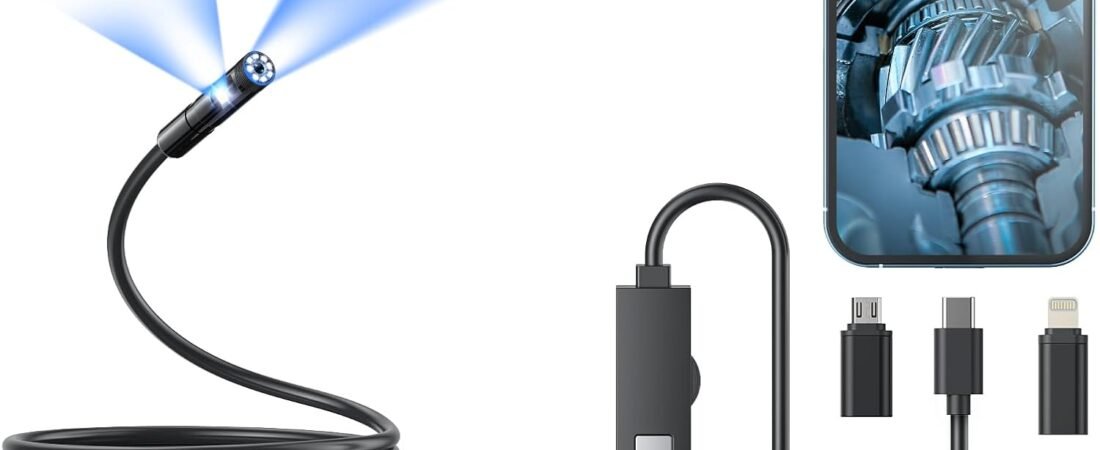
The Endoscope Camera with Light, 1920P HD Borescope Tools with 8 Adjustable LED Lights, Semi-Rigid Snake Camera, IP67 Waterproof Inspection Borescope for iOS and Android, 16.4FT Dual-Lens is designed around this type of inspection workflow. Its specifications describe several features intended to make inspection more flexible, including high-definition imaging, eight adjustable LED lights, a semi-rigid probe, dual-camera capability, a long 16.4-foot inspection cable, and an IP67-oriented waterproof design.
These features can make the device useful for a broad range of visual inspection tasks. Automotive work, plumbing, home maintenance, HVAC inspection, appliance troubleshooting, DIY projects, and locating objects are all possible applications.
At the same time, a consumer borescope has practical limitations. Image resolution does not automatically determine image quality, a long probe does not guarantee that every space can be reached, and an IP67 rating must be understood correctly rather than interpreted as unlimited underwater capability.
This guide explains how this type of dual-lens inspection camera works, what its major features mean, how it can be used, and what users should consider before relying on it for a particular inspection.
What Is a Borescope or Endoscope Camera?
A borescope is a small visual inspection device designed to provide access to spaces that are difficult to see directly.
A typical system includes a camera mounted at the end of a narrow probe. The camera captures the environment, while a connected display or smartphone shows the live image.
The concept is simple but useful.
Instead of removing a component just to see what is behind it, a user may be able to insert a camera through an existing opening and inspect the area first.
This can save time during troubleshooting and can reduce unnecessary disassembly.
Borescopes are used in many professional fields, including mechanical maintenance, automotive inspection, plumbing, HVAC work, industrial maintenance, and building inspection. Consumer models can provide a more accessible way for homeowners, hobbyists, and DIY users to perform basic visual checks.
The product discussed here adds several features that can broaden its inspection capabilities, particularly the dual-lens design and relatively long semi-rigid probe.
Key Features
1920P HD Image Specification
The product is described as offering 1920P HD imaging.
Higher-resolution inspection imagery can help make visible details easier to distinguish, particularly when examining surfaces, mechanical components, or objects at relatively close range.
However, the term “1920P” should be viewed as a resolution-related specification rather than a guarantee of a particular level of image quality in every environment.
The actual image can also depend on:
- Camera sensor performance
- Lens quality
- Lighting
- Working distance
- Camera movement
- Surface condition
- Moisture
- Reflections
- The connected device and application
For example, a camera may provide a detailed image under good lighting but appear less useful inside a very dark or reflective cavity.
Resolution is therefore one part of the inspection system rather than the entire picture.
Dual-Lens Camera Design
One of the most notable features of this configuration is the dual-lens design.
A dual-camera inspection system can provide more than one viewing direction, depending on how the cameras are arranged and controlled.
This can be useful because a conventional forward-facing inspection camera generally shows whatever is directly in front of the lens.
When examining a pipe or mechanical cavity, the user may need to look forward in one moment and inspect a nearby side surface in another.
A second lens can potentially make this type of observation easier without requiring the user to completely reposition the probe.
The exact behavior of the dual-lens system depends on the product’s camera arrangement and controls, so users should consult the current instructions for information about switching between camera views.
Eight Adjustable LED Lights
Lighting is fundamental to inspection work.
The inside of a pipe, engine compartment, appliance cavity, or wall opening can be almost completely dark.
The product is described as having eight adjustable LED lights.
Multiple LEDs can provide illumination around the camera and help reveal nearby surfaces.
Adjustability is particularly useful because different environments require different amounts of light.
A dark cavity may require stronger illumination, while a shiny metal surface may produce excessive reflections when the LEDs are at maximum brightness.
Being able to adjust illumination can therefore help the operator balance visibility and glare.
Semi-Rigid Snake Camera
The probe is described as semi-rigid.
This is an important distinction from a completely soft and flexible cable.
A semi-rigid inspection probe can retain some of the shape given to it by the user. That can make it easier to guide the camera through a particular route.
For example, the user may bend the probe slightly before inserting it so that the camera naturally points toward a desired area.
This can be helpful when the inspection involves reaching around an obstacle.
However, semi-rigid does not mean rigid.
The probe can still bend and may require careful positioning when navigating complicated spaces.
16.4-Foot Inspection Cable
A 16.4-foot cable provides substantial reach for many household and workshop applications.
The additional length can be useful when the inspection point is relatively far from the operator.
Potential examples include:
- Long accessible pipes
- Automotive areas
- Large machinery
- HVAC sections
- Building cavities
- Areas beneath structures
- Hard-to-reach spaces
Longer probes can increase the range of an inspection, but they can also become more difficult to control.
The farther the camera travels into a confined space, the more important careful probe management becomes.
IP67 Waterproof Protection
The product is described as IP67 waterproof.
The IP, or Ingress Protection, system classifies protection against solid particles and water under defined test conditions.
An IP67 rating generally indicates that the relevant protected component is designed to be dust-tight and capable of withstanding temporary immersion under specified laboratory conditions.
This distinction is important.
IP67 does not mean the device can be used indefinitely underwater or in every wet environment.
The exact component covered by the rating also matters. A camera probe may have a different environmental tolerance than the control unit, connectors, or smartphone used with it.
Users should follow the manufacturer’s instructions for water exposure.
How It Can Be Used
Automotive Inspection
Automotive work is one of the most practical applications for a long inspection probe.
Vehicles contain numerous enclosed spaces where direct visibility is limited.
A borescope may help inspect:
- Difficult engine-bay areas
- Behind mechanical components
- Accessible cavities
- Areas where debris has accumulated
- Locations around hoses and wiring
- Hard-to-view mechanical sections
A dual-lens design can be particularly useful when the user wants to examine both the direction of travel and nearby surfaces.
For example, a forward-facing view may show an object ahead while another viewing direction may help inspect the surrounding area.
The camera can also help locate a dropped fastener before removing multiple components.
Automotive inspections require caution, however. Engines and exhaust components can become extremely hot, while belts, fans, pulleys, and other components can move unexpectedly.
The probe should not be placed near moving machinery, and the equipment should be used within its environmental temperature limitations.
Plumbing and Drain Inspection
A long inspection probe can be useful for examining accessible pipe sections.
The camera may help identify visible:
- Debris
- Buildup
- Foreign objects
- Obstructions
- Standing water
- Surface damage
The ability to inspect a pipe visually can sometimes help determine whether a problem appears to be near the access point.
However, consumer borescopes have limitations.
A pipe system can contain multiple branches, sharp bends, heavy blockages, or areas that are simply inaccessible to the camera.
A professional plumbing inspection system may provide specialized features for navigating these conditions.
HVAC Inspection
Heating and ventilation systems can contain long and narrow spaces that are difficult to examine from the outside.
A long inspection camera can potentially help inspect accessible sections of ducts and equipment.
It may be used to look for visible debris, physical damage, or other conditions.
Temperature is an important consideration.
Some HVAC equipment can become hot, and the camera should not be exposed to temperatures beyond its specified operating range.
The probe should also not interfere with moving fans, dampers, or other mechanical components.
Home Maintenance
Around the home, an inspection camera can help investigate areas that are difficult to access.
Examples include:
- Behind appliances
- Under cabinets
- Inside accessible wall cavities
- Beneath decks
- Around ventilation openings
- Behind furniture
- Inside larger equipment
- Narrow structural spaces
For example, if an object disappears behind a large appliance, a camera may provide enough visibility to locate it before the appliance is moved.
Appliance Troubleshooting
Appliances can contain enclosed areas where debris or small objects become trapped.
An inspection camera may help determine what is happening inside an accessible cavity.
However, electrical safety is critical.
The camera should not be inserted into energized electrical equipment merely because the probe is insulated or waterproof-rated.
Some appliances also contain capacitors or other components capable of retaining electrical energy after being disconnected.
When internal electrical components are involved, appropriate professional procedures should be followed.
DIY and Workshop Projects
A semi-rigid inspection camera can be useful for DIY projects because it can be shaped before insertion.
This can help when the operator knows approximately which direction the camera needs to travel.
Potential workshop applications include:
- Inspecting machinery
- Finding dropped parts
- Checking equipment cavities
- Examining mechanical assemblies
- Investigating blocked spaces
- Looking behind structures
The camera provides visual information without necessarily requiring immediate disassembly.
Finding Lost Objects
A long probe can be useful when an object falls into a narrow or deep space.
Common examples might include:
- Screws
- Bolts
- Tools
- Toys
- Jewelry
- Cables
- Small components
Once the camera locates the object, another tool can be selected for retrieval.
For example, a magnetic pickup tool may be useful for ferrous metal objects.
The inspection camera itself is primarily a viewing device rather than a retrieval tool.
Inspection Around Vehicles and Equipment
The long probe can also be useful when inspecting areas underneath vehicles or around large equipment.
The camera can provide a view into spaces that would otherwise require the operator to position their body in an awkward location.
However, users should never place themselves underneath an improperly supported vehicle simply because the camera can reach underneath it.
Proper jack stands and other safety equipment remain essential when working beneath vehicles.
Who It May Be Suitable For
DIY Homeowners
A homeowner who frequently handles maintenance projects may find a borescope useful for visual investigation.
It can help determine whether a hidden problem appears serious before deciding on the next step.
Automotive Enthusiasts
Vehicle hobbyists can use a long probe to inspect difficult areas without immediately removing multiple components.
The dual-lens configuration can provide additional viewing flexibility.
Plumbing and Maintenance Users
People responsible for maintaining buildings, equipment, or plumbing systems may use an inspection camera as a preliminary visual tool.
Workshop Users
A semi-rigid probe can be useful for workshop environments because it can be shaped and positioned more easily than a very soft cable.
HVAC and Mechanical Hobbyists
Users working on ventilation systems, machinery, and mechanical projects may appreciate the longer reach and integrated lighting.
Technicians as a Supplementary Tool
Professionals may also use consumer inspection cameras for quick visual checks, depending on the application.
However, professional environments can require specialized equipment with specific certifications, image quality, probe articulation, measurement capabilities, or environmental ratings.
A consumer borescope should not automatically be considered a substitute for specialized professional inspection systems.
Important Things to Consider
Measure the Camera Head
Before inserting the probe into a narrow opening, determine whether the camera head will physically fit.
The cable may be flexible, but the camera head still has a fixed physical size.
If the opening is smaller than the camera assembly, the probe should not be forced through it.
Long Probes Require Careful Handling
A 16.4-foot cable provides useful reach, but a long probe can also be harder to control.
When the camera is far inside a space, small movements at the operator’s end may produce larger or less predictable movements at the camera.
Advance slowly.
If the image becomes confusing, stop and reposition rather than continuing forward.
Semi-Rigid Does Not Mean Self-Supporting
A semi-rigid probe can maintain some shape, but it may still bend under its own weight or when it encounters an obstacle.
Users should not assume that the probe will remain perfectly straight over a long distance.
Dual-Lens Systems Require Familiarization
A dual-camera setup can provide more viewing flexibility, but users may need some time to understand how the different views relate to the physical orientation of the probe.
Before inspecting something important, practice switching between the camera views.
Lighting Can Create Glare
Eight adjustable LEDs can provide strong illumination, but more light is not always better.
Metallic surfaces, polished components, glass, and water can reflect light directly into the camera.
If the image appears washed out, try changing the camera angle or reducing illumination rather than assuming the camera lacks detail.
Waterproofing Has Limits
An IP67 rating should be interpreted according to the relevant test standard and the component to which it applies.
Do not assume that the entire inspection system, smartphone, connectors, or control unit can be submerged.
Also consider chemicals and contaminated water.
Water resistance does not automatically mean resistance to every liquid, solvent, oil, or cleaning chemical.
Heat Can Damage the Camera
A waterproof inspection camera may still have relatively limited temperature tolerance.
Automotive engines, exhaust systems, ovens, boilers, and heating equipment can become hot enough to damage electronics.
Verify the specified operating temperature before using the camera in a hot environment.
Electrical Safety Comes First
A camera’s small size should never be mistaken for electrical safety.
Do not insert the probe into energized electrical panels, outlets, wiring systems, or appliances unless the inspection procedure has been specifically designed for that environment and performed by an appropriately qualified person.
A borescope is not an electrical tester.
Smartphone Compatibility
The product is described as supporting iOS and Android.
Even when an inspection camera supports both platforms, users should verify the current compatibility requirements, operating-system version, connector type, and application requirements.
Smartphone hardware can vary considerably between models.
Wireless or App Connectivity
If the particular configuration uses a phone application or connection method, users should become familiar with the setup before beginning an important inspection.
A connection problem can be frustrating if it is discovered only after the camera has already been inserted into a difficult location.
Working Distance
The camera will generally produce its most useful image within a practical working range.
Being extremely close to an object does not automatically provide a clearer picture.
Experiment with distance and angle when inspecting a surface.
Lens Contamination
Oil, dust, water droplets, and debris on the camera lens can significantly reduce image clarity.
A clean lens is especially important when working in automotive or plumbing environments.
Follow the manufacturer’s cleaning instructions rather than using aggressive chemicals that could damage the lens or seals.
General Comparison With Other Inspection Categories
Dual-Lens Borescope Versus Single-Lens Borescope
A single-lens inspection camera normally provides one primary viewing direction.
A dual-lens system can offer additional viewing flexibility, depending on how the cameras are positioned.
This can be useful in spaces where both forward and nearby side views are important.
A single-lens camera can still be sufficient for straightforward inspections where the viewing direction is predictable.
Long Probe Versus Short Probe
A 16.4-foot probe provides more reach than a short inspection cable.
This can be helpful for long pipes, large equipment, and distant inspection points.
However, longer probes can be harder to control.
A short probe may be more convenient for small household tasks where the target is close to the opening.
Semi-Rigid Probe Versus Flexible Cable
A very flexible cable can navigate complicated bends.
A semi-rigid probe can be easier to guide in a desired direction because it retains some shape.
The ideal choice depends on the environment.
Complex curved pathways may favor flexibility, while controlled positioning can benefit from a semi-rigid design.
Smartphone Borescope Versus Dedicated Display
A smartphone-based camera can be convenient because the phone provides a familiar screen, storage, and software environment.
A dedicated inspection system may be more self-contained.
Using a phone also means compatibility and app requirements must be considered.
Borescope Versus Flashlight
A flashlight illuminates an area from outside.
A borescope carries the camera and light source into the area being inspected.
For an accessible open space, a flashlight may be simpler.
For a narrow cavity, the camera provides an entirely different level of visibility.
Borescope Versus Thermal Camera
A standard borescope shows visible-light images.
A thermal camera displays temperature differences.
If the goal is to inspect physical surfaces, debris, mechanical components, or visible damage, a borescope can provide relevant information.
If the problem involves temperature anomalies, thermal imaging is a different tool.
A Practical Inspection Workflow
A systematic approach can improve the usefulness of an inspection camera.
Step 1: Define the Problem
Know what you are trying to find.
Are you looking for an obstruction, a damaged component, a lost object, or evidence of buildup?
A clear objective helps determine where the camera should go.
Step 2: Identify a Safe Access Point
Whenever possible, use an existing opening.
Do not drill into walls or equipment without checking for electrical wiring, plumbing, structural components, or other hazards.
Step 3: Check the Camera
Inspect the lens and probe before insertion.
Make sure there is no obvious damage or contamination.
Step 4: Connect the Viewing Device
If the system requires a smartphone or application, establish the connection before inserting the camera.
This avoids navigating a confined space without a live image.
Step 5: Position the Probe
Shape the semi-rigid cable according to the intended path.
Avoid sharp bends that could damage the cable.
Step 6: Start Slowly
Move the camera gradually.
Watch how the environment changes and identify landmarks that help you understand the camera’s location.
Step 7: Use the Dual-Lens Function
When appropriate, switch between the available viewing directions to examine surrounding areas.
This can be particularly useful when a forward view does not show enough of the nearby structure.
Step 8: Adjust the LEDs
Increase or reduce illumination depending on the environment.
Watch for glare on shiny surfaces.
Step 9: Document Findings
If the system supports photos or video, capture important observations.
Documentation can be useful when explaining a problem to a professional or comparing conditions later.
Step 10: Withdraw Carefully
After the inspection, remove the probe slowly.
Do not pull forcefully if the camera becomes caught.
Improving Image Quality During an Inspection
Several simple techniques can make a major difference.
First, keep the camera lens clean.
Second, control the camera’s distance from the subject.
Third, move slowly.
Fourth, change viewing angles when the image is unclear.
Fifth, use appropriate lighting rather than simply maximum brightness.
Sixth, stabilize the probe whenever possible.
A shaky camera can make a detailed inspection much harder to interpret.
When inspecting reflective materials, changing the angle often reveals more than increasing the light.
Automotive Safety Considerations
Automotive inspection can expose the camera and operator to several hazards.
Allow hot components to cool when appropriate.
Keep the probe away from moving belts, fans, pulleys, and other machinery.
Do not rely on a camera to determine whether a vehicle is safely supported.
If working underneath a vehicle, use appropriate support equipment.
Also consider fluids, chemicals, battery terminals, sharp edges, and other hazards.
The camera can improve visibility, but it does not remove the underlying risks of working around a vehicle.
Plumbing and Drain Safety
Pipes can contain contaminated water, chemicals, pressure, or sharp internal surfaces.
Before inserting the camera, understand what the pipe carries and whether it can be safely opened.
After use, clean the probe appropriately.
Avoid using a contaminated inspection camera in clean environments without proper cleaning.
An inspection camera can show visible conditions, but it may not identify the exact cause of a plumbing problem.
Using an Endoscope Around Walls
An inspection camera can be useful for looking inside a wall cavity when an appropriate access opening already exists.
However, creating an opening specifically for the camera requires caution.
Walls can contain:
- Electrical wiring
- Plumbing
- Structural elements
- Insulation
- Communication cables
A camera should not be used as a substitute for proper detection and safety procedures before drilling.
Maintenance and Storage
After each inspection, clean the camera and probe according to the manufacturer’s instructions.
Pay particular attention to the camera lens.
If the probe was used around oil, mud, drain water, or other contaminants, clean it before storage.
Store the cable without crushing or sharply bending it.
A long semi-rigid probe should not be tightly wrapped into a small coil if doing so places unnecessary stress on the cable.
Protect connectors from moisture and contamination.
If a smartphone is used for viewing, disconnect the equipment carefully and store any required accessories together.
Frequently Asked Questions
What is a dual-lens endoscope camera?
A dual-lens endoscope camera uses two camera views to provide additional visual flexibility during an inspection. Depending on the design, users may be able to switch between different viewing directions.
What does 1920P HD mean?
The term refers to a high-definition image specification associated with the camera’s video output. Actual image quality also depends on the lens, sensor, lighting, distance, and environment.
How long is the inspection probe?
The product is described as having a 16.4-foot inspection cable.
What is the advantage of a 16.4-foot probe?
The additional length can help reach inspection points farther from the operator, including some longer pipes, machinery, vehicles, and building cavities.
Is a long probe always better?
Not necessarily. Longer probes provide greater reach but can also be more difficult to control. The ideal length depends on the intended inspection.
What does IP67 mean?
IP67 generally indicates protection against dust ingress and temporary immersion under defined testing conditions for the protected component. It does not mean unlimited underwater use.
Can the camera be submerged?
Only within the limits specified by the manufacturer. Users should verify which components have the IP67 rating and how long and deep water exposure is permitted.
Can it be used in drains?
It may be suitable for visual inspection of appropriate accessible drain sections, provided the environmental conditions are within the camera’s specifications and the equipment is cleaned afterward.
Can it inspect an engine?
A borescope can be useful for visual inspection of appropriate engine areas. Hot and moving components must be avoided, and the camera’s temperature limits should be respected.
Can it be used for HVAC inspection?
It can potentially inspect accessible HVAC areas, but users should consider temperature, moving components, electrical hazards, and the physical construction of the system.
Does the dual-lens design let the camera see in every direction?
No. Dual-lens systems provide additional viewing capability, but they do not provide unlimited 360-degree visibility. The camera’s physical orientation and lens arrangement still determine what can be seen.
Why are eight LED lights useful?
Multiple adjustable LEDs can provide illumination in dark inspection environments. Adjustable brightness can also help reduce glare when examining reflective surfaces.
Why does the image look too bright?
Reflective materials can direct the camera’s light back into the lens. Reducing illumination or changing the viewing angle may improve the image.
Why is the image blurry?
Possible causes include a dirty lens, unsuitable working distance, moisture, poor lighting, or movement. Cleaning the lens and adjusting the camera’s distance can help.
Can the camera find lost objects?
Yes. Locating dropped or hidden objects is one practical application for a long inspection camera.
Can it see through walls?
No. A standard optical inspection camera cannot see through solid wall material. It requires an access opening.
Can it replace professional inspection equipment?
Not in every situation. Professional inspection equipment can offer specialized features and capabilities that consumer cameras may not provide.
Does a semi-rigid probe bend?
Yes. Semi-rigid probes are designed to retain some shape while still allowing controlled bending.
Can the probe be forced through a blockage?
It is better not to force it. Excessive pressure can damage the camera, cable, or inspected equipment and may cause the probe to become trapped.
Is the camera compatible with iPhone and Android devices?
The product is described as supporting iOS and Android. Users should verify the current supported operating-system versions, connection requirements, and application details for their specific device.
Can it record inspection images?
Recording capabilities depend on the specific hardware and software configuration. Users should check the current product documentation for supported photo and video functions.
What should I do before an important inspection?
Charge the equipment, clean the lens, test the smartphone connection if applicable, confirm the access opening, and perform a short trial inspection before committing to the full task.
Conclusion
The 1920P HD Dual-Lens Endoscope Camera with 8 Adjustable LED Lights, Semi-Rigid Snake Camera, IP67 Waterproof Design, and 16.4-foot probe is designed to provide a flexible way to inspect spaces that are difficult to see directly.
Its combination of long reach, integrated lighting, dual-camera capability, and semi-rigid probe can make it useful for a broad range of visual inspection tasks.
Automotive enthusiasts can use a borescope to investigate difficult-to-reach areas. Homeowners can use it for maintenance and locating objects. DIY users can inspect equipment and structures. Plumbing and HVAC applications may also benefit from the ability to view accessible internal spaces without immediately dismantling everything.
The dual-lens design can add another dimension to the inspection process by providing alternative viewing directions. The eight adjustable LEDs can help illuminate dark spaces while allowing the user to manage glare. The 16.4-foot probe offers substantial reach, although that additional length also requires careful handling.
The IP67 rating is another useful feature, but it should be interpreted within the limits of the applicable protection standard. Water resistance does not mean that every component can be submerged indefinitely, and exposure to chemicals, extreme temperatures, or contaminated environments requires additional consideration.
Most importantly, an inspection camera should be treated as a visual information tool. It can reveal what is visible inside a confined space, but it cannot automatically diagnose every mechanical, plumbing, structural, or electrical problem.
Good inspection technique remains important. Choose a safe access point, keep the lens clean, move the probe slowly, adjust lighting when necessary, use the dual-lens views appropriately, and avoid forcing the camera into restricted areas.
When used within its intended capabilities, a long dual-lens borescope can provide a practical way to gather visual information before deciding whether further maintenance, testing, or professional inspection is necessary.