Inspecting a narrow or enclosed space can be surprisingly difficult. A flashlight may illuminate the entrance, but it does not necessarily show what is happening deeper inside. Removing panels or dismantling equipment simply to see a hidden component can also turn a small investigation into a much larger project.
An endoscope camera, often called a borescope or inspection camera, provides another approach. A small camera mounted at the end of a probe can be inserted through an accessible opening, allowing the user to view areas that would otherwise be difficult to see directly.
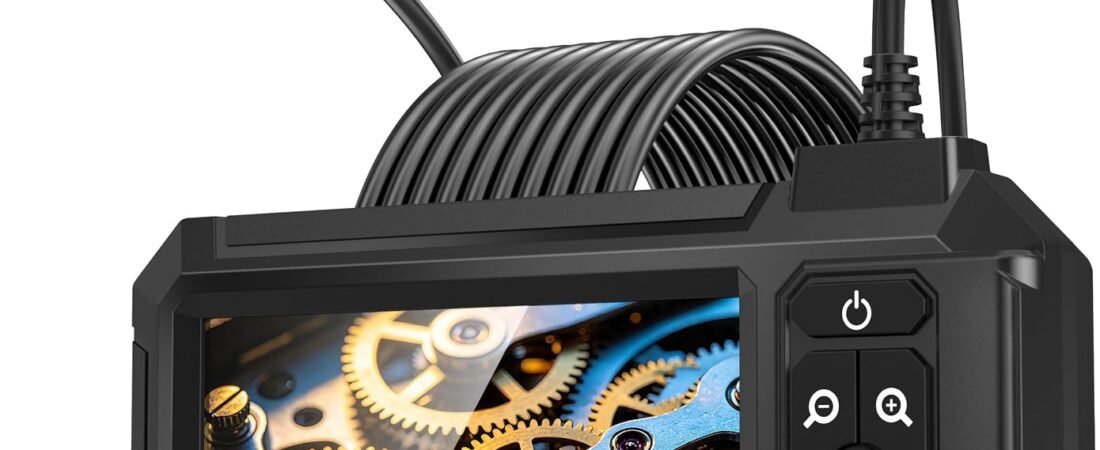
The Endoscope Camera with Light, 1080P HD Borescope with 4.3-inch IPS Screen is designed around this type of inspection workflow. Instead of requiring a smartphone or computer as the primary viewing device, the inclusion of a dedicated 4.3-inch IPS screen creates a self-contained way to view the camera feed.
This type of equipment can be useful for automotive inspection, plumbing-related checks, home maintenance, HVAC work, machinery troubleshooting, DIY projects, and locating objects in confined spaces. Its usefulness depends on the physical dimensions of the camera, probe design, illumination, working distance, and the environment being inspected.
A borescope is also an observation tool rather than a universal diagnostic instrument. Seeing something unusual does not automatically identify the cause of a problem, and some situations still require professional testing or disassembly.
This guide explains the major features and concepts behind a 1080P inspection camera with a 4.3-inch IPS display, practical applications, limitations, safety considerations, and how this type of device compares with other inspection methods.
What Is an Endoscope Camera?
An endoscope camera is a compact visual inspection system designed to look into areas that are difficult to reach with ordinary cameras.
The basic system usually includes:
- A miniature camera
- An inspection probe
- Integrated illumination
- A display
- Controls for operating the camera
- A power source
The camera is placed at the end of the probe. The user guides the probe into an accessible opening while watching the live image on the display.
This arrangement can be helpful because the camera can physically travel into the area being inspected.
For example, imagine trying to determine whether something has fallen behind an appliance. A conventional camera may not fit into the available space, while an inspection camera with a narrow probe may provide a view without requiring the appliance to be moved immediately.
The same principle applies to automotive components, pipes, equipment housings, ventilation areas, and other confined spaces.
Key Features
1080P HD Imaging
The 1080P designation refers to a high-definition video format commonly associated with a resolution of approximately 1920 × 1080 pixels.
For inspection work, image resolution can affect how easily small visible details can be distinguished.
A higher-resolution image may make it easier to observe things such as:
- Surface damage
- Debris
- Corrosion
- Cracks
- Loose components
- Accumulated material
- Mechanical wear
However, resolution is not the only factor that determines image quality.
Lighting, camera sensor performance, lens design, working distance, movement, and the condition of the inspected surface all influence what the user sees.
A 1080P camera can provide detailed imagery, but it should not be interpreted as a guarantee that every inspection environment will appear perfectly clear.
4.3-Inch IPS Screen
One of the defining features of this configuration is its dedicated 4.3-inch IPS screen.
IPS, or In-Plane Switching, is a display technology commonly associated with wide viewing angles and consistent image presentation.
A dedicated screen has an important practical advantage: the user does not necessarily need to rely on a smartphone as the viewing device.
This can make the inspection process more straightforward.
Instead of inserting the camera into a tight area while simultaneously trying to position a phone for viewing, the screen can be held in the user’s hands while the probe is guided separately.
A dedicated display can also be useful in environments where a personal smartphone would be inconvenient to handle, such as a workshop, garage, or dusty maintenance area.
Integrated Camera Lighting
Inspection environments are often dark.
A camera placed inside an engine compartment, pipe, appliance cavity, or ventilation space may receive little or no ambient light.
An integrated light near the camera allows the system to illuminate the area being viewed.
Lighting quality can have a major effect on inspection results.
Too little illumination can hide important details. Excessive direct light can create glare when the camera is pointed at shiny metal, glass, wet surfaces, or other reflective materials.
The most useful lighting level therefore depends on the material and environment.
Flexible Inspection Probe
A flexible probe allows the camera to reach around obstacles and into spaces that are not directly visible from the opening.
This flexibility is particularly useful in areas containing bends or obstructions.
At the same time, a flexible probe can be more difficult to control precisely than a rigid inspection instrument.
Users may need to rotate or reposition the probe gradually to orient the camera toward the area of interest.
Patience is often more useful than force when navigating a narrow space.
Self-Contained Viewing Approach
A dedicated screen changes the overall workflow compared with smartphone-dependent inspection cameras.
With a smartphone-based system, the user typically needs to connect the camera to a compatible phone and use an application or software interface.
A system with an integrated display can reduce dependence on another device.
This may be useful for workshops, garages, maintenance environments, or situations where a separate smartphone connection would be inconvenient.
Why the Display Matters During Inspection
The screen is not simply an accessory. It changes how the inspection can be performed.
When the camera enters a confined space, the operator needs immediate visual feedback.
A dedicated screen makes it possible to watch the camera’s position while moving the probe.
This is particularly useful when navigating around corners.
Without live visual feedback, the operator would have to rely more heavily on assumptions about where the camera is pointing.
A 4.3-inch display also provides a larger viewing surface than the tiny image that might be visible on some compact devices.
The user can hold the display at a comfortable viewing distance while manipulating the probe with the other hand.
For workshop work, this two-part arrangement can be practical because the screen and probe can be positioned independently.
How It Can Be Used
Automotive Inspection
Automotive maintenance is one of the most common applications for borescopes.
Modern vehicles contain numerous areas that can be difficult to inspect directly.
An inspection camera may be useful for viewing:
- Tight engine-bay spaces
- Areas behind components
- Interior cavities
- Hard-to-see mechanical areas
- Locations where debris may accumulate
- Accessible areas around hoses or wiring
For example, if a small component or fastener falls into an inaccessible area, a borescope may help determine where it went before additional parts are removed.
It can also provide a visual reference during troubleshooting.
However, automotive environments contain significant hazards.
Engines, exhaust components, fans, belts, and other parts can become extremely hot or move unexpectedly. The appropriate safety procedures should be followed, and the probe should never be inserted near moving components while the equipment is operating unless the inspection method specifically allows it and appropriate professional precautions are in place.
Plumbing Inspection
A borescope can be useful for inspecting accessible sections of pipes and drains.
It may help users identify visible:
- Debris
- Buildup
- Obstructions
- Standing water
- Surface damage
- Foreign objects
This can be useful when investigating a drainage issue before deciding whether more extensive work is necessary.
There are limitations, however.
Long pipe systems can contain multiple bends, branches, or obstructions. A consumer inspection camera may not reach the actual source of a problem.
Professional plumbing inspection systems may have longer probes, specialized camera heads, articulation controls, and other features designed specifically for pipe inspection.
Home Maintenance
Around the home, there are many situations where visibility is restricted.
An inspection camera may help examine:
- Behind appliances
- Under cabinets
- Accessible wall cavities
- Narrow storage spaces
- Ventilation openings
- Areas beneath structures
- Equipment interiors
- Spaces behind furniture
For example, if a small object falls into a narrow gap, the camera may help determine whether the object is visible and where it is located.
This can prevent unnecessary dismantling.
HVAC and Ventilation
Ventilation systems often contain enclosed sections that are difficult to inspect without access openings.
An inspection camera can potentially provide a visual look at accessible portions of ducts or equipment.
It may help identify visible dust accumulation, debris, physical damage, or other conditions.
Temperature is an important consideration here.
Heating systems can expose equipment to elevated temperatures, and users should verify the applicable temperature limits before inserting a consumer inspection camera into a warm or hot environment.
Appliance Inspection
Household appliances may contain narrow spaces where objects, debris, or buildup can become difficult to see.
A borescope can sometimes help inspect these areas.
For example, it may be useful for locating an object that has fallen inside an appliance cavity or examining a component that is difficult to access directly.
Electrical safety is critical.
A camera should not be inserted into energized electrical equipment simply because it is small enough to fit.
Turning off a device may not eliminate every electrical hazard, especially in equipment containing stored electrical energy.
DIY Projects
DIY users can find many uses for an inspection camera.
During repair work, the camera can help answer questions about what lies behind an opening or inside a structure.
This may be useful for:
- Furniture restoration
- Mechanical projects
- Equipment repair
- Hobby electronics
- Home maintenance
- Small construction projects
- Finding lost components
The camera can serve as an information-gathering tool before deciding how much disassembly is necessary.
Locating Lost Objects
Another straightforward application is finding small objects in difficult locations.
A screw, tool, toy, cable, piece of jewelry, or other object may fall behind equipment or into a narrow cavity.
An inspection camera can help determine the object’s location.
The camera does not retrieve the object itself, but knowing exactly where the object is can make the recovery process easier.
Workshop Inspection
A home workshop often contains equipment with enclosed sections.
A borescope can provide a convenient way to look inside machinery or around components without immediately taking everything apart.
It can also be useful for checking the condition of parts before beginning maintenance.
Who It May Be Suitable For
DIY Homeowners
Homeowners who regularly perform repairs and maintenance may find an inspection camera useful as a general diagnostic accessory.
It can provide information before moving furniture, removing panels, or dismantling equipment.
Automotive Enthusiasts
People who work on vehicles as a hobby can use a borescope to inspect difficult-to-reach areas.
The dedicated screen can also be convenient in a garage environment where handling a smartphone may be inconvenient.
Maintenance Workers
Maintenance personnel may use inspection cameras as supplementary visual tools.
The device can help provide a quick look at confined areas before more extensive inspection procedures are performed.
Workshop Users
DIY mechanics, hobbyists, and repair enthusiasts can benefit from having a compact camera available when working on equipment.
Home Inspectors and Technicians
A consumer-grade borescope may be useful as a supplemental visual tool, although professional inspection requirements may call for specialized equipment with additional capabilities or certifications.
Important Things to Consider
Measure the Access Opening
The camera head must physically fit through the opening being inspected.
Before inserting the probe, measure the available space where possible.
A flexible cable cannot compensate for a camera head that is too large.
Also consider whether there is enough room for the camera to move once inside.
Resolution Is Not Everything
1080P provides a useful image-resolution specification, but the final result depends on the entire optical system.
A dirty lens can make a high-resolution camera look poor.
Low light can obscure details.
A reflective surface can produce glare.
Moving the camera too quickly can make the image difficult to interpret.
Understanding these limitations helps set realistic expectations.
Working Distance Matters
Small inspection cameras have a practical distance at which the subject appears clearest.
Holding the camera directly against a surface may not produce the best image.
Experimenting with the distance and viewing angle can reveal more detail.
Avoid Excessive Force
If the probe stops moving, do not automatically push harder.
The camera could be caught against an internal component or bend.
Forcing the probe can damage the equipment or the object being inspected.
A better approach is often to withdraw the probe slightly, rotate it, and try another angle.
Waterproofing Requires Careful Interpretation
Some inspection cameras are designed with water-resistant or waterproof camera sections.
This does not necessarily mean that the complete system can be submerged.
The display, controls, connectors, and other components may have different environmental limitations.
Always follow the manufacturer’s stated protection specifications.
Heat Can Be a Serious Limitation
Automotive engines, exhaust systems, heating equipment, ovens, and industrial machinery can become hot enough to damage consumer electronics.
Do not insert the camera into a hot environment unless the equipment is specifically rated for the temperature involved.
Electrical Safety
Never use an inspection camera as a substitute for electrical testing equipment.
Do not insert the probe into energized electrical panels, outlets, appliances, or other hazardous electrical environments unless a qualified professional has determined that the inspection method is safe.
Electric shock, arc flash, fire, and equipment damage are possible hazards.
Keep the Lens Clean
The camera lens is small and can easily collect dust, oil, water droplets, or fingerprints.
Even a small amount of contamination can affect image clarity.
Clean the camera according to the manufacturer’s instructions after inspections, particularly after working in dirty mechanical or plumbing environments.
Consider Probe Flexibility
A flexible probe is useful for navigating bends, but it may not maintain a precise orientation.
When examining a particular component, move slowly and watch how the image changes as the probe rotates.
General Comparison With Other Inspection Methods
Borescope Versus Flashlight
A flashlight can illuminate an accessible area, but it cannot show what lies around a corner or deep inside a narrow cavity.
A borescope combines illumination with a camera, allowing the user to see what the camera itself sees.
A flashlight remains more useful for larger, open areas.
The two tools can complement each other.
Borescope Versus Smartphone Camera
A smartphone typically has a larger display and sophisticated image processing.
However, the phone itself cannot normally enter narrow mechanical spaces.
An inspection camera sacrifices some smartphone convenience in exchange for a small probe that can physically reach restricted areas.
A dedicated-display borescope also avoids relying on a smartphone during the inspection.
Borescope Versus Professional Inspection Camera
Professional inspection equipment can offer specialized features such as longer probes, articulating camera heads, interchangeable tips, enhanced durability, higher-resolution imaging, specialized lighting, or advanced recording functions.
A consumer borescope can still be useful for routine visual checks but should not automatically be considered equivalent to professional inspection systems.
Borescope Versus Thermal Camera
A standard inspection camera captures visible images.
A thermal camera detects infrared radiation and displays temperature differences.
If the goal is to see physical conditions such as debris, cracks, or visible damage, a standard borescope may be appropriate.
If the goal is to locate abnormal temperature patterns, thermal imaging serves a different purpose.
Borescope Versus Mirror Inspection Tool
Traditional inspection mirrors allow users to see around corners without electronics.
They are simple and do not require batteries.
However, their usefulness depends on the available viewing angle and lighting.
A borescope provides live electronic imagery and its own illumination, making it more versatile in very dark or confined areas.
Making an Inspection More Effective
Using an inspection camera effectively involves more than inserting the probe.
A structured process can make the results easier to interpret.
Identify the Target
Before beginning, determine exactly what you are looking for.
Are you checking for an obstruction? Looking for a lost object? Examining surface damage?
Having a clear target helps you decide where to position the camera.
Choose an Appropriate Access Point
Use an existing opening whenever possible.
Avoid creating unnecessary holes simply to insert the camera.
If drilling is required, check carefully for electrical wiring, plumbing, structural elements, and other hazards before creating an access point.
Start Near the Opening
Begin with the camera close to the entrance.
This provides a reference point and allows you to understand how the image changes as the camera moves.
Move Slowly
Slow movements make it easier to understand the environment.
Rapidly pushing the probe forward can cause the camera to pass an important feature without giving the operator enough time to notice it.
Change the Angle
If something appears unclear, rotate the camera.
A surface may reflect light differently from another direction.
A crack or opening can also become easier to identify from a different angle.
Adjust Lighting When Appropriate
Use enough illumination to reveal details without creating unnecessary glare.
If the environment is highly reflective, changing the camera position may be more effective than simply increasing brightness.
Document Important Findings
If the system supports image or video recording, documentation can be useful.
A captured image may help when discussing a problem with a mechanic, plumber, technician, or other professional.
Documentation can also make it easier to compare an area before and after maintenance.
Automotive Inspection Safety
Automotive use deserves additional attention because vehicles combine heat, electricity, fluids, and moving machinery.
Before inspecting an engine compartment, consider whether the engine should be off and allowed to cool.
Avoid moving belts, fans, pulleys, and other mechanical components.
Do not place the probe near hot exhaust components.
Be cautious around battery terminals, exposed wiring, fuel systems, and chemicals.
The inspection camera is intended to provide visual information. It should not be used as a reason to enter a dangerous mechanical area.
Plumbing Inspection Safety
Plumbing systems can contain pressure, chemicals, contaminated water, sharp edges, and other hazards.
Before inserting the probe, determine whether the pipe contains pressurized material or hazardous substances.
After inspecting a dirty drain or pipe, clean the camera according to the manufacturer’s instructions.
The same probe should not be casually transferred from contaminated plumbing work to clean environments.
Using the Camera Around Appliances
Before inspecting inside an appliance, follow the appliance manufacturer’s safety instructions.
Disconnecting power may be appropriate for some inspections, but some appliances contain stored energy or other hazards even after being unplugged.
Do not assume that a small camera can safely enter every internal compartment.
When in doubt, professional service may be the appropriate option.
Storage and Maintenance
A flexible probe should be stored without excessive bending or crushing.
Avoid wrapping the cable around very small objects if doing so creates a sharp bend.
Keep the camera lens clean.
Protect the display from impacts and excessive moisture.
After use in dusty or dirty environments, clean the equipment before storing it.
If the device contains a rechargeable battery, follow the manufacturer’s charging and storage recommendations.
A simple maintenance routine can help preserve both image quality and physical condition.
Frequently Asked Questions
What is a 1080P borescope used for?
A 1080P borescope is designed to provide visual access to narrow or difficult-to-reach spaces. It can be used for automotive inspection, plumbing-related checks, home maintenance, appliance troubleshooting, DIY work, and other visual inspection tasks.
What is the purpose of the 4.3-inch IPS screen?
The 4.3-inch IPS display provides a dedicated viewing surface for the camera feed. It allows users to see the inspection image without necessarily relying on a smartphone.
Does an IPS screen improve the camera image itself?
No. IPS is a display technology. It affects how the image is presented on the screen, while camera resolution, lens quality, sensor performance, lighting, and other factors determine the captured image.
Can this type of camera inspect inside pipes?
It can be useful for viewing accessible pipe sections if the camera and probe fit through the opening. Long or complex pipe systems may require specialized professional equipment.
Can it be used for automotive work?
A borescope can be useful for viewing difficult-to-reach automotive areas. However, heat, moving components, electrical systems, and other vehicle hazards must be considered.
Is the camera waterproof?
The exact level of water protection depends on the product’s specifications. Users should verify the manufacturer’s stated protection rating and avoid assuming that the entire system is waterproof simply because the camera probe is designed for damp environments.
Can it be used underwater?
Only if the manufacturer specifically states that the relevant components are rated for the intended underwater use. A water-resistant probe does not automatically mean the complete system can be submerged.
Can it inspect an engine?
It may be useful for visual inspection of appropriate engine areas, but temperature and mechanical hazards must be considered. Hot or moving engine components can damage the camera or create safety risks.
Can the camera see through walls?
No. A conventional inspection camera does not see through solid wall material. It can inspect a wall cavity only if there is an appropriate opening through which the probe can pass.
Can it find objects that have fallen into narrow spaces?
Yes, locating lost objects is one practical use for an inspection camera. The camera can help identify the object’s position before the user attempts to retrieve it.
Is 1080P enough for inspection work?
For many general visual inspection tasks, 1080P can provide useful detail. However, image quality also depends on lighting, focus, camera optics, movement, and working distance.
Why does the image look blurry?
Possible causes include a dirty lens, unsuitable working distance, poor lighting, moisture on the lens, or rapid camera movement. Cleaning the lens and adjusting the distance or angle can help.
Why does a shiny surface look washed out?
Reflective surfaces can bounce the camera’s built-in light directly toward the lens. Changing the camera angle or illumination can sometimes reduce glare.
Can the probe be pushed through a blockage?
It is generally better not to force the probe. Excessive pressure can damage the camera or become trapped inside the inspected space.
Can the inspection camera replace a professional technician?
Not in every situation. It can provide useful visual information, but professional diagnosis may require specialized instruments, measurements, experience, or equipment.
Can it be used around electrical wiring?
Only with appropriate safety precautions and within the manufacturer’s intended use. The camera should not be inserted into energized electrical equipment as a substitute for electrical testing.
Can it be used for HVAC inspection?
It can provide visual information in accessible HVAC areas, provided the environment is within the equipment’s temperature and environmental limitations.
How should the camera be cleaned?
Follow the manufacturer’s cleaning instructions. In general, keeping the lens free from dirt, oil, and moisture is important for maintaining image clarity.
Is a dedicated screen better than a smartphone?
They serve different purposes. A dedicated screen eliminates the need to connect another device and can be convenient in workshops and maintenance environments. A smartphone may offer a larger software ecosystem and additional recording or sharing features.
Does a longer probe always make an inspection camera better?
Not necessarily. Probe length should match the intended application. A very long probe can be harder to control, while a shorter probe may be easier to manage in compact spaces.
Conclusion
The Endoscope Camera with Light, 1080P HD Borescope with 4.3-inch IPS Screen is designed to address a practical inspection challenge: seeing into places that are difficult or impossible to view directly.
Its combination of a high-definition inspection camera, integrated illumination, flexible probe, and dedicated 4.3-inch IPS display provides a self-contained approach to visual inspection.
For automotive enthusiasts, DIY homeowners, workshop users, maintenance personnel, and people who occasionally need to investigate hidden spaces, an inspection camera can provide valuable information before more extensive disassembly or professional inspection becomes necessary.
The dedicated screen is particularly relevant because it keeps the inspection process independent of a smartphone. The operator can hold the display while guiding the camera through a confined area, making it easier to watch the live image as the probe moves.
The 1080P specification provides a useful level of image detail, but it is important to keep expectations realistic. Resolution alone does not determine image quality. Lighting, camera optics, working distance, surface reflections, movement, and environmental conditions all influence the final view.
Safety is equally important. Automotive engines, electrical systems, plumbing, HVAC equipment, appliances, and machinery can all contain hazards that a small camera does not eliminate. The camera should be treated as a visual inspection tool, not as permission to enter dangerous environments.
Compared with a flashlight or inspection mirror, a borescope provides a live camera view from inside the restricted area. Compared with a smartphone-based inspection camera, a dedicated-display design can simplify the workflow. Compared with professional inspection equipment, a consumer system may have fewer specialized capabilities but can still be useful for routine visual checks.
Used thoughtfully, an inspection camera can turn a difficult visual problem into a more manageable one. It allows users to gather information, document visible conditions, and make better-informed decisions about whether additional maintenance, testing, or professional assistance is necessary.