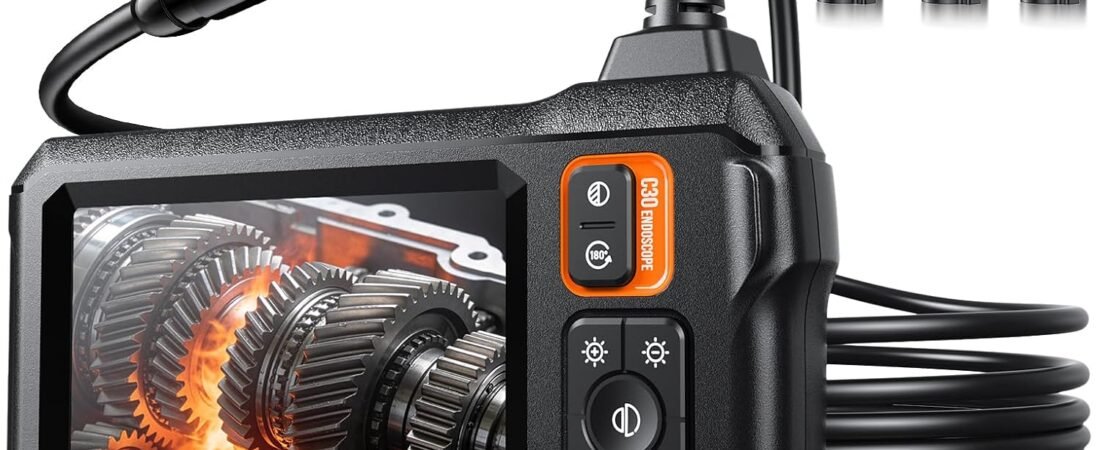
Inspecting a narrow or enclosed space can be surprisingly difficult. A pipe, engine compartment, wall cavity, appliance interior, drain, or other hard-to-reach area may contain useful information about a problem, but physically reaching the area is often impractical. In situations like these, an endoscope camera can provide another way to look inside without immediately taking everything apart.
The Endoscope Camera with Light, identified as a 1920P HD borescope with a 16.5-foot cable, is designed around this inspection concept. A small camera at the end of a flexible cable can be guided into confined spaces while the connected viewing device displays what the camera sees. Built-in lighting can help illuminate areas that would otherwise be too dark to inspect.
Borescopes and inspection cameras are used across many different activities. Homeowners may use them for basic inspection tasks, automotive enthusiasts can examine difficult-to-access engine areas, and maintenance workers can use inspection cameras to look inside machinery or other equipment.
The technology is useful, but it is not a substitute for every type of inspection. Image quality depends on lighting, distance, lens position, surface conditions, cable placement, and the viewing system. A camera may also reveal that a problem exists without necessarily explaining its cause.
This guide examines the practical role of a 1920P HD endoscope camera with a 16.5-foot cable, including its key characteristics, possible applications, limitations, maintenance considerations, and differences between general categories of inspection equipment.
What Is an Endoscope Camera?
An endoscope camera, sometimes called a borescope or inspection camera, is designed to provide visual access to spaces that are difficult to see directly.
The basic system usually consists of three main components:
- A small camera at the end of a cable or probe
- A flexible cable that allows the camera to be positioned
- A display or connected device used to view the camera image
Many inspection cameras also include built-in LEDs around the camera lens.
The idea is straightforward. Instead of dismantling a component simply to see inside it, the camera can sometimes be inserted through an existing opening.
This can make preliminary inspection faster and less disruptive.
For example, a homeowner may want to investigate an inaccessible cavity behind an appliance. An automotive enthusiast may want to look into a difficult engine area. A maintenance worker may need to inspect a narrow mechanical compartment.
The usefulness of the equipment depends heavily on whether there is an appropriate access point.
An endoscope camera does not create an opening where none exists. It works best when there is already a suitable passage through which the camera and probe can safely travel.
Key Features of the 1920P HD Borescope
1920P HD Image Specification
The product is identified as a 1920P HD endoscope camera.
Resolution is one factor that influences the amount of visual detail captured by a camera. A higher-resolution image can potentially make small features easier to distinguish than a lower-resolution image.
However, resolution should not be interpreted as a guarantee of perfect inspection quality.
Actual image clarity also depends on lens quality, lighting, focus, camera distance, surface texture, movement, and the display used to view the image.
A camera positioned too far away from an object may still produce limited detail even if the nominal resolution is relatively high.
Likewise, dust, oil, water droplets, reflective surfaces, or poor lighting can reduce visibility.
The most useful way to think about the 1920P specification is as part of the overall imaging system rather than as a standalone measure of inspection capability.
16.5-Foot Cable
The product is identified with a 16.5-foot inspection cable.
A relatively long cable can be useful when the area being inspected is not immediately adjacent to the user.
For example, a longer probe can provide additional reach inside:
- Vehicle compartments
- Large appliances
- Walls and cavities
- Pipes
- Machinery
- Attics
- Crawl spaces
- Other confined areas
The actual usable reach depends on the flexibility and handling characteristics of the cable.
A longer cable does not necessarily mean that the camera will be easier to control.
As the cable travels farther into a narrow space, positioning can become more difficult. Curves, corners, friction, and obstacles can all affect movement.
Users should therefore consider cable length together with cable flexibility and the geometry of the inspection area.
Built-In Lighting
Inspection areas are often dark.
A camera inserted inside an engine compartment, pipe, wall cavity, or appliance cannot rely on ordinary room lighting.
A built-in LED light near the camera can illuminate the area immediately in front of the lens.
Lighting is especially important because camera exposure and image quality depend on the amount of light reaching the sensor.
Too little light can make surfaces difficult to distinguish.
At the same time, highly reflective surfaces can create glare when the camera’s LEDs point directly at them.
The best image may therefore require adjusting the camera angle or light intensity rather than simply increasing brightness.
Compact Camera Tip
An inspection camera needs a small enough camera head to enter the intended space.
The compact tip allows the device to reach areas that may otherwise be visually inaccessible.
However, users should never assume that the camera head will fit through every opening.
Before inserting it, measure the available opening if dimensions are critical.
It is also important to make sure that the camera head is not forced into a passage that is too narrow.
Flexible Probe
The flexible cable allows the camera to be guided through spaces that are not perfectly straight.
This is useful for inspection work because many real-world spaces contain curves, bends, corners, or obstacles.
The flexibility also creates a learning curve.
A camera cable does not necessarily move exactly in the same direction as the user’s hand. When the probe is inserted deeper, small movements at the user’s end can produce larger or less predictable changes at the camera end.
Controlled movement is therefore important.
How an Endoscope Camera Can Be Used
Automotive Inspection
Automotive work is one of the most common applications for borescope-style cameras.
A camera can potentially help inspect areas that are difficult to see without disassembling components.
Possible applications include looking into accessible engine spaces, examining hard-to-see areas around mechanical components, checking cavities, and locating objects that have fallen into difficult areas.
An inspection camera can be particularly useful as a preliminary diagnostic tool.
For example, a mechanic or enthusiast may use the camera to determine whether further disassembly is necessary.
However, a visual inspection does not replace proper mechanical testing.
If a component is suspected to be damaged, the camera may provide useful evidence, but additional diagnostic procedures may still be required.
Inspecting Pipes and Drains
An endoscope camera can also be useful for certain pipe and drain inspections.
If an accessible opening is large enough for the camera head, the probe can sometimes be guided through a section of pipe to look for visible obstructions, buildup, or other conditions.
This can help identify where a problem may be located.
There are important limitations, however.
A camera does not necessarily identify the composition of a blockage, determine structural integrity, or diagnose every plumbing problem.
Water exposure is another consideration.
Users should verify the camera’s environmental specifications before placing the device into a wet environment. A general inspection camera should not automatically be assumed to be suitable for submerged operation.
Home Inspection
Homeowners may use inspection cameras to examine areas that are difficult to reach.
Potential applications include looking behind appliances, inside accessible cavities, under cabinets, or around certain construction spaces.
A camera can sometimes help determine whether further investigation is necessary.
For example, if something appears unusual behind an appliance, the camera may help provide a closer view without immediately moving heavy equipment.
However, structural, electrical, plumbing, or safety-related findings should not automatically be interpreted as a professional diagnosis.
Appliance Inspection
Many appliances contain narrow spaces where a direct visual inspection is difficult.
A borescope can potentially provide a view into accessible sections of an appliance.
This can be useful when trying to locate an object, inspect buildup, or identify visible damage.
Electrical safety is critical.
An appliance should be disconnected from power before performing any inspection that requires access to internal electrical areas, unless a qualified professional is specifically performing live diagnostic work using appropriate procedures and equipment.
HVAC and Ventilation Areas
Inspection cameras can be useful for viewing certain accessible ventilation or HVAC spaces.
A camera may help identify visible dust accumulation, foreign objects, or other conditions.
However, HVAC systems can contain moving components, electrical connections, sharp metal edges, and other hazards.
The inspection camera should not be inserted into an operating system where doing so could expose the user or equipment to danger.
Finding Lost Objects
A small object can sometimes fall behind furniture, inside equipment, or into a difficult-to-reach cavity.
An inspection camera can help locate the object before the user starts dismantling the surrounding area.
This can be particularly useful when the opening is too narrow for a hand but large enough for the camera probe.
Construction and Renovation
During home improvement projects, inspection cameras can sometimes provide visual access behind surfaces where an appropriate opening already exists.
For example, a camera may be used through an existing access point to inspect a cavity.
However, users should exercise caution before drilling or cutting into walls.
Electrical wiring, plumbing, structural components, and other hazards may be present.
An inspection camera can help when an opening already exists, but it should not be treated as a guarantee that an unseen area is safe to penetrate.
Who May Find an Endoscope Camera Useful?
DIY Enthusiasts
People who perform household maintenance may appreciate a tool that allows visual inspection before disassembly.
Automotive Enthusiasts
Vehicle owners who perform their own maintenance can use a borescope for certain visual inspection tasks.
Homeowners
An inspection camera can help investigate difficult-to-see spaces around a property.
Maintenance Workers
Professionals working with equipment and machinery may use inspection cameras as part of broader diagnostic procedures.
The suitability depends on the specific industry, inspection requirements, and safety standards.
Plumbers and Technicians
Inspection cameras can be useful for certain accessible pipe and equipment inspections.
Professional applications may require specialized cameras with additional characteristics such as waterproofing, articulation, recording, measurement, or specialized probes.
Important Things to Consider
Resolution Does Not Guarantee Diagnostic Accuracy
A high-resolution image can provide more visual information, but it does not automatically identify a problem.
The camera may show discoloration, cracks, buildup, corrosion, or an unfamiliar object without explaining exactly what caused it.
Interpretation requires context and, for some applications, professional expertise.
Camera Access Is Essential
An endoscope can only inspect areas that the probe can physically reach.
The presence of a camera does not eliminate the need for an access point.
Users should identify the entry location before beginning.
Measure the opening if the camera’s physical dimensions are important.
Cable Length Is Not the Same as Effective Reach
The 16.5-foot cable provides substantial physical length, but the practical inspection distance may be lower depending on the environment.
A cable traveling through multiple bends can become difficult to control.
A long probe may also be harder to retract smoothly.
Users should insert the cable gradually and avoid forcing it.
Lighting Affects Image Quality
The camera’s LEDs are useful, but lighting conditions still affect what can be seen.
Reflective metal can produce glare.
Dark or textured surfaces may absorb light.
Dust or moisture near the lens can obscure the image.
Moving the camera closer, changing its angle, or adjusting the light can sometimes improve visibility.
Water Exposure
Before using an inspection camera around water, verify its actual water-resistance specifications.
Terms such as “waterproof” can have different meanings depending on the product and manufacturer.
A camera that is suitable for a damp environment is not necessarily suitable for prolonged submersion.
The connector, cable, camera head, and display system may also have different levels of environmental protection.
Temperature
Some inspection environments can become extremely hot.
Engine compartments, heating systems, industrial machinery, and other equipment may contain high-temperature components.
Do not insert a camera into a high-temperature environment unless the manufacturer’s specifications specifically support it.
Excessive heat can damage the camera and create safety risks.
Electrical Safety
A camera should never be inserted into an energized electrical environment unless the equipment and procedure are specifically designed for that purpose and the operator is qualified.
For ordinary home inspection, disconnecting equipment from power before opening or inspecting internal areas is an important safety measure.
A borescope should not be treated as electrical test equipment.
Comparing General Inspection Camera Categories
Basic Borescopes vs. Professional Inspection Systems
Basic borescopes can be useful for general visual inspection.
Professional systems may provide additional features such as articulated camera tips, interchangeable probes, higher environmental ratings, specialized lighting, recording systems, measurement functions, or advanced displays.
For occasional household tasks, a simpler inspection camera may be sufficient.
For industrial inspection, professional equipment may be required because of safety, documentation, precision, or regulatory requirements.
Flexible Borescopes vs. Rigid Inspection Cameras
Flexible probes can travel through curved paths.
Rigid inspection cameras are generally easier to control in straight or predictable spaces.
A flexible cable is more versatile but can be more difficult to position accurately as the distance increases.
Wired Inspection Cameras vs. Wireless Inspection Cameras
Wired systems connect the camera to a display through a physical cable.
This can provide a direct connection between the camera and viewing system.
Wireless inspection cameras can provide greater freedom around the viewing device but may introduce additional considerations involving wireless range, battery life, connection stability, and software.
Endoscope Cameras vs. Traditional Inspection Mirrors
An inspection mirror is a simple mechanical tool that allows the user to see around corners.
It does not require batteries or electronics.
An endoscope camera can provide a view inside much narrower spaces and can potentially display or record an image, depending on the system.
The mirror is simpler, while the camera provides more visual information in situations where the probe can physically reach the target.
Inspection Cameras vs. Professional Scope Equipment
Professional scopes are often designed around specific industries.
They may include specialized probes, measurement systems, articulation, higher environmental protection, and documentation capabilities.
A general-purpose endoscope can be useful for basic inspection but should not automatically be considered equivalent to specialized professional equipment.
Tips for Using a 16.5-Foot Inspection Cable
Plan the Route First
Before inserting the cable, determine where you want the camera to go.
Identify bends, openings, and possible obstacles.
This reduces the chance of getting the probe stuck.
Insert Slowly
Slow movements generally provide better control than pushing the cable rapidly.
Watch the display while advancing the camera.
If the image changes unexpectedly or the cable stops moving, do not force it.
Avoid Sharp Bends
Although the probe is flexible, forcing it around an extremely tight corner can damage the cable or camera.
If the cable does not naturally follow the available route, reconsider the inspection path.
Keep the Lens Clean
The camera lens is the most important visual component.
Dust, grease, fingerprints, condensation, and debris can obscure the image.
Clean the lens using an appropriate method recommended by the manufacturer.
Use Lighting Carefully
If the image appears dark, additional illumination may help.
However, maximum brightness is not always the best solution.
Reflective surfaces can create glare, making details harder to see.
Try changing the camera angle as well.
Using an Endoscope for Automotive Work
An inspection camera can be useful during vehicle maintenance because modern vehicles contain many areas that are difficult to view directly.
For example, a camera may help inspect certain cavities or areas around mechanical components.
Before inserting the camera, make sure the vehicle and component are in a safe condition.
Avoid moving belts, fans, rotating components, hot surfaces, and energized electrical areas.
If the engine has recently been running, allow appropriate components to cool before beginning an inspection unless a qualified procedure specifically requires otherwise.
The camera can provide visual information, but it does not replace proper automotive diagnostic equipment.
A mechanic may still need compression testing, electrical testing, pressure testing, or physical disassembly depending on the suspected issue.
Using an Endoscope for Plumbing
Inspection cameras can provide useful visual information inside accessible pipes.
A user may be able to observe:
- Visible buildup
- Foreign objects
- Certain obstructions
- Pipe interior conditions
- Changes in the apparent pipe surface
The camera should be advanced carefully.
Pipes can contain sharp edges, sludge, standing water, and other conditions that may affect the probe.
After use in dirty environments, the probe should be cleaned according to the manufacturer’s instructions.
Do not assume that visual inspection alone establishes the structural condition of a plumbing system.
For significant leaks, recurring blockages, suspected pipe damage, or property-related water problems, professional assessment may still be appropriate.
Using an Endoscope Around the Home
One of the advantages of a general-purpose inspection camera is that homeowners may find many occasional uses for it.
For example, if a small object falls behind an appliance, the camera may help determine where it is.
If there is an existing opening into a wall cavity, the camera may provide a closer look inside.
If a household appliance has an accessible compartment, the camera may help identify visible buildup or foreign objects.
These applications can save unnecessary disassembly.
However, users should always distinguish visual inspection from diagnosis.
Seeing something unusual does not necessarily establish what caused it or how serious it is.
Storage and Maintenance
The inspection camera should be stored according to the manufacturer’s instructions.
Keep the cable organized without creating excessively tight bends.
Avoid placing heavy objects on the camera head or cable.
Clean the probe after use, especially if it has been exposed to dust, oil, dirt, or other contaminants.
Inspect the camera tip and cable periodically for damage.
If the camera has been exposed to moisture, follow the manufacturer’s guidance before storing or connecting the device.
Proper maintenance is particularly important for a flexible probe because repeated sharp bending or pulling can eventually damage internal components.
Frequently Asked Questions
What is an endoscope camera used for?
An endoscope camera is used to visually inspect areas that are difficult to see directly. Common applications include automotive inspection, household maintenance, equipment inspection, certain plumbing tasks, and locating objects in confined spaces.
What does 1920P HD mean?
The product is identified as a 1920P HD inspection camera. The resolution specification describes an aspect of the image system, but actual visual clarity also depends on lighting, lens quality, distance, surface conditions, movement, and the display.
How long is the inspection cable?
The product is identified as having a 16.5-foot cable. The practical reach depends on how the cable can be routed through the inspection area.
Can the camera inspect inside walls?
It may be useful for looking inside an existing accessible cavity, but users should not assume that the camera makes it safe to drill or cut into an unknown wall. Electrical wiring, plumbing, and structural components can be present.
Can it be used for automotive inspection?
An endoscope can be useful for certain visual inspection tasks around vehicles. It should not be inserted near moving, hot, or energized components unless the appropriate safety procedures and equipment are in place.
Can it be used in pipes?
It may be suitable for inspecting accessible pipe interiors depending on the product’s environmental specifications and camera dimensions. Users should verify water-resistance requirements before exposing the camera to water.
Is a borescope the same as an endoscope camera?
The terms are often used interchangeably for industrial, automotive, household, and mechanical inspection cameras. Medical endoscopes are a separate category of specialized medical equipment.
Does a higher resolution guarantee a better inspection?
No. Resolution is only one part of image quality. Lighting, focus, lens quality, distance, movement, and the condition of the surface being inspected all matter.
Can the 16.5-foot cable reach around corners?
The flexible cable can be routed through suitable curved spaces, but the actual ability to navigate corners depends on the cable’s flexibility, the size of the passage, friction, and the geometry of the space.
Can the camera be submerged?
Users should not assume that it can be submerged simply because it is marketed as an inspection camera. Check the manufacturer’s specific water-resistance rating and operating instructions before exposing the camera to water.
Can it inspect a hot engine?
A recently operated engine can contain extremely hot components. The camera should only be used within the temperature limits specified by the manufacturer. Allowing equipment to cool can be an important safety precaution.
Can an endoscope diagnose a mechanical problem?
It can provide visual information that may help identify possible issues, but a camera does not necessarily establish the cause or severity of a mechanical problem. Additional testing may be required.
Is this type of camera suitable for professional inspections?
Suitability depends on the professional application. Basic inspection cameras can be useful for some maintenance tasks, while regulated, industrial, or safety-critical inspections may require specialized equipment with documented specifications.
Can the camera be used to find lost objects?
Yes, locating objects in narrow or difficult-to-reach spaces is one potential application, provided the camera can safely access the area.
How should the cable be handled?
Insert it gradually and avoid forcing it around sharp bends or obstacles. Keep the cable organized during storage and avoid excessive kinking.
Why does the image sometimes look blurry?
Blur can result from distance, focus limitations, movement, poor lighting, condensation, dirt on the lens, or the surface being inspected. Adjusting the camera position or cleaning the lens may help.
Conclusion
The Endoscope Camera with Light, identified as a 1920P HD borescope with a 16.5-foot cable, is designed to provide visual access to spaces that are difficult to inspect directly.
Its long flexible probe can be useful when the inspection point is located deeper inside an accessible cavity, while built-in lighting helps illuminate dark environments. The high-resolution designation can provide useful image detail, although actual inspection quality depends on several factors beyond resolution alone.
There are many possible applications.
Automotive enthusiasts can use inspection cameras for certain hard-to-see areas. Homeowners may find them useful for investigating accessible cavities, appliances, and storage spaces. Maintenance users can potentially inspect equipment without immediately dismantling it. The camera can also assist with locating objects that have fallen into narrow spaces.
At the same time, an inspection camera has clear limitations.
It cannot safely reach every location, and a long cable does not automatically make difficult bends easy to navigate. Water, heat, electricity, moving machinery, and structural hazards all require careful consideration. A visual image can also provide evidence without necessarily providing a complete diagnosis.
For occasional DIY inspection, maintenance, automotive investigation, and general-purpose visual access, an endoscope camera can be a practical addition to a toolkit. Its greatest value comes from using it as an inspection aid rather than treating it as a substitute for professional diagnostic equipment when the situation requires specialized expertise.
Before using an inspection camera, identify the access point, understand the environmental conditions, check the manufacturer’s specifications, and move the probe carefully. These simple precautions can help protect both the equipment and the area being inspected.