Seeing into a narrow or enclosed space can be difficult without the right equipment. A component may be hidden behind other parts, a pipe may be too narrow for direct viewing, or an object may have fallen into an area that cannot be reached comfortably by hand. Taking everything apart just to determine what is happening can also turn a simple inspection into a much larger project.
An endoscope camera, also called a borescope or inspection camera, provides an alternative approach. Instead of relying entirely on direct line-of-sight, a small camera can be guided through an accessible opening and used to display an image of the area ahead.
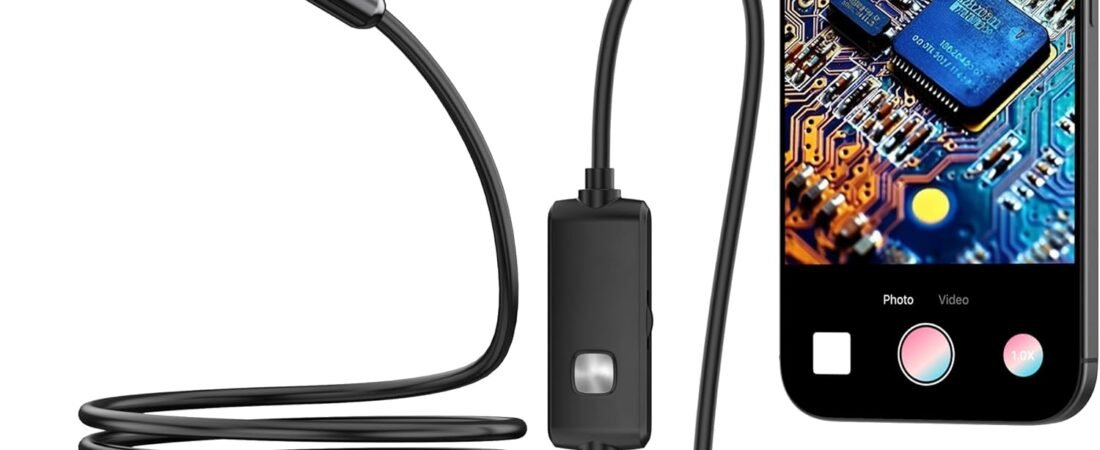
The Endoscope Camera with Light described here is identified as a 1920P HD borescope equipped with eight adjustable LED lights. The combination of a compact camera, flexible inspection design, and adjustable illumination is intended to help users examine dark and confined spaces.
Inspection cameras can have many practical applications. A homeowner may use one to look inside an accessible wall cavity. An automotive enthusiast may inspect a difficult-to-see area of a vehicle. A DIY user may use a camera to locate a lost object behind furniture or inside equipment. Maintenance workers may use similar equipment as part of a broader inspection process.
However, a borescope is not a universal diagnostic tool. Image quality depends on lighting, distance, camera position, lens condition, and the surface being examined. Environmental factors such as water, heat, dust, and moving machinery can also affect whether an inspection is safe.
This guide explains the practical characteristics of a 1920P HD endoscope camera with eight adjustable LED lights, including its possible uses, important limitations, maintenance considerations, and how it compares with other general inspection tools.
What Is an Endoscope Camera?
An endoscope camera is a compact visual inspection device designed to help users see areas that are difficult to observe directly.
A typical system consists of a small camera at the end of a probe or cable and a method for displaying the camera’s image.
The camera can be guided through an opening into a confined area.
Depending on the design, the viewing system may be a dedicated display or a compatible electronic device.
The concept is particularly useful when the area being inspected is:
- Narrow
- Deep
- Enclosed
- Poorly illuminated
- Difficult to access directly
- Located behind another component
The camera does not eliminate the need for an opening. It simply allows the user to make use of an existing access point more effectively.
This distinction is important.
An inspection camera can help someone look through an existing opening, but it should not be treated as a reason to drill into a wall, dismantle an appliance, or enter an electrical compartment without first considering the hazards.
Key Features of the 1920P HD Borescope
1920P HD Imaging
The product is identified as a 1920P HD endoscope camera.
Resolution describes an important characteristic of the image system. Higher image resolution can provide more visual information than a lower-resolution image under suitable conditions.
For inspection work, additional detail can be useful when examining surfaces, components, labels, buildup, or other small visual features.
However, resolution alone does not determine image quality.
The final image is also influenced by:
- Lens quality
- Camera distance
- Lighting
- Focus
- Movement
- Surface texture
- Reflections
- The viewing display
For example, a high-resolution camera positioned too far from a small object may still provide limited useful detail.
Similarly, an oily, dusty, wet, or reflective surface may be difficult to interpret regardless of nominal resolution.
The 1920P specification should therefore be considered as one part of the inspection system rather than a guarantee of a particular diagnostic result.
Eight Adjustable LED Lights
One of the defining features of this product is the inclusion of eight adjustable LED lights.
Lighting is particularly important for inspection cameras because many of the spaces they enter have little or no natural illumination.
The LEDs are positioned around the camera area to help illuminate the subject.
Adjustability is useful because different surfaces respond differently to light.
A dark surface may require additional illumination, while a shiny metal surface may create glare when illuminated directly.
Being able to adjust the lighting can give the user more control over the viewing environment.
For example, lowering the illumination may help reduce reflections on a polished surface, while increasing it can make a dark cavity easier to see.
The actual control range and brightness characteristics should be confirmed in the current product documentation.
Compact Camera Design
An inspection camera needs to be small enough to enter the intended space.
The camera tip is therefore designed for confined-area inspection.
This can be useful when looking into machinery, appliances, automotive areas, pipes, cavities, or other spaces where a conventional camera would not fit.
Before using the camera, it is important to verify that the opening is large enough.
Never force the camera into a passage that is too narrow.
A stuck camera can be difficult to retrieve and may damage both the inspection equipment and the object being inspected.
Flexible Inspection Probe
A flexible probe allows the camera to travel through spaces that are not perfectly straight.
This is one of the main reasons borescopes are useful.
A rigid camera would be limited to relatively direct paths, while a flexible probe can potentially navigate bends and curves.
Flexibility also requires technique.
As the probe becomes longer and travels deeper, movement at the user’s end may not translate into an identical movement at the camera tip.
The cable may also encounter friction against the walls of a narrow passage.
Slow and controlled insertion is therefore preferable to forcing the probe forward.
Integrated Illumination
The LED lights are positioned near the camera so that the area being viewed can be illuminated directly.
This is different from shining a flashlight from outside an opening.
External light may not reach around corners or deep into an enclosed cavity.
Camera-mounted LEDs can provide illumination much closer to the subject.
This can make visual inspection possible in areas that would otherwise appear completely dark.
How the Endoscope Camera Can Be Used
Automotive Inspection
Automotive maintenance is one of the most common areas where inspection cameras can be useful.
Modern vehicles contain many components that are difficult to inspect directly.
A borescope may help users visually examine accessible areas around engines, mechanical assemblies, cavities, or other components.
Possible uses include looking for visible debris, inspecting surfaces, locating objects, or checking areas before deciding whether further disassembly is necessary.
The camera can therefore function as a preliminary inspection tool.
However, a visual image does not automatically diagnose a mechanical problem.
For example, seeing a mark on a component does not necessarily establish whether the mark is normal wear, damage, contamination, or something else.
Additional testing may still be necessary.
Inspecting Pipes
A small inspection camera can sometimes be inserted into an accessible pipe opening.
The user may be able to see portions of the interior surface and identify certain visible conditions.
Potential observations can include:
- Visible buildup
- Foreign objects
- Certain obstructions
- Surface discoloration
- Changes in the interior appearance
The effectiveness depends heavily on the pipe’s diameter, bends, material, and internal condition.
A camera designed for general inspection should not automatically be considered a professional sewer inspection system.
Long plumbing runs, standing water, heavy deposits, and complex pipe configurations may require specialized equipment.
Home Maintenance
Homeowners often encounter spaces that are difficult to inspect visually.
Examples include areas behind appliances, under cabinets, inside accessible cavities, or around equipment.
An endoscope can sometimes provide a view without requiring immediate removal of surrounding objects.
This can be useful when looking for a lost item or investigating an obvious but hard-to-see area.
However, if the inspection involves electrical wiring, structural components, gas systems, or other safety-critical areas, professional assessment may be appropriate.
Appliance Inspection
Appliances often contain narrow internal areas.
An inspection camera may help locate foreign objects or provide a visual look at an accessible section.
Before inspecting an appliance, disconnect it from electrical power when appropriate.
Never insert a camera into a powered electrical assembly unless the equipment and inspection procedure are specifically designed for energized work and the operator is qualified.
An endoscope is a visual tool, not an electrical testing instrument.
HVAC and Ventilation Inspection
An inspection camera may be useful for certain accessible sections of HVAC or ventilation systems.
It can potentially help identify visible dust, debris, or foreign objects.
However, ventilation systems can contain moving fans, electrical components, sharp edges, and temperature hazards.
The system should be safely shut down before inspection where appropriate.
Professional HVAC inspection equipment may also be more appropriate for larger or more complex systems.
Locating Lost Objects
A small item can easily disappear behind furniture, inside equipment, or through a narrow opening.
An endoscope can provide a visual path into areas that are difficult to reach with a conventional flashlight.
For example, a user might inspect beneath an appliance or inside a narrow cavity before moving heavy equipment.
This can save time when the location of the object is uncertain.
DIY and Home Improvement
During renovation or maintenance projects, an inspection camera can sometimes help users see through existing openings.
For example, an existing access point may provide a view inside a cavity.
The camera can help identify what is visible without immediately enlarging the opening.
However, it is important not to assume that a camera view guarantees that an area is safe to drill or cut.
A limited camera view may not reveal wiring, pipes, or structural elements outside the camera’s field of view.
Who May Find This Type of Borescope Useful?
DIY Enthusiasts
People who perform household maintenance can use an inspection camera as a preliminary visual tool.
Automotive Enthusiasts
Vehicle owners who perform their own maintenance may find a borescope useful for certain difficult-to-see areas.
Homeowners
An endoscope can help investigate accessible cavities, appliances, and other enclosed spaces.
Maintenance Personnel
Technicians can use visual inspection cameras as part of broader maintenance procedures.
The appropriate equipment depends on the industry and inspection requirements.
Plumbers and Mechanical Workers
An inspection camera can assist with certain visual checks where an appropriate access point exists.
Professional environments may require specialized systems with specific environmental ratings, articulation, recording, measurement, or documentation capabilities.
Important Things to Consider
Image Resolution Is Not the Whole Story
A 1920P HD designation provides information about image resolution, but it does not guarantee that every small detail will be visible.
Distance is particularly important.
The farther the camera is from the object, the smaller that object appears in the image.
Lighting also affects detail.
A well-lit surface may be much easier to inspect than a dark surface even when both are viewed with the same camera.
Eight LEDs Do Not Guarantee Perfect Illumination
Multiple LEDs provide additional control over the lighting environment, but they do not eliminate every lighting problem.
Reflective metal can produce glare.
Dark surfaces can absorb light.
Dust or moisture near the camera lens can scatter illumination.
The best image may require adjusting both the lighting and camera position.
Consider the Probe Diameter
Before inserting the camera, make sure the camera tip will fit through the opening.
This is especially important for pipes, automotive cavities, and mechanical components.
Never force the probe.
Cable Flexibility Has Limits
A flexible cable can navigate bends, but extremely sharp corners or complex passages may still be difficult.
The camera can also become harder to control as it travels deeper.
Slow movements and careful positioning can improve control.
Water Resistance Must Be Verified
An inspection camera should not be placed in water unless its specifications specifically permit that use.
Even if a camera is marketed for plumbing or outdoor applications, users should check the formal environmental rating.
The camera head, cable, connectors, and viewing device may not necessarily have identical protection levels.
Heat Can Damage Inspection Equipment
Some inspection areas can become extremely hot.
Examples include engine compartments, heating equipment, exhaust-related components, and industrial machinery.
Do not insert the camera into a hot environment unless the manufacturer’s temperature specifications support it.
Electrical Areas Require Special Caution
An inspection camera should not be inserted into energized electrical equipment unless it is specifically designed and rated for that purpose and used by a qualified person.
For normal household inspection, disconnect equipment from power when appropriate.
Do not confuse visual inspection with electrical testing.
Comparing General Inspection Camera Categories
General-Purpose Borescopes vs. Professional Inspection Cameras
General-purpose borescopes are often designed for household maintenance, automotive use, and basic visual inspection.
Professional inspection systems may provide additional capabilities such as:
- Articulating camera tips
- Specialized probes
- Higher environmental ratings
- Advanced image processing
- Measurement features
- Recording and documentation
- Interchangeable camera heads
For occasional DIY use, a general-purpose system may provide sufficient functionality.
Safety-critical or regulated inspections can require specialized professional equipment.
Flexible vs. Rigid Inspection Cameras
Flexible probes are useful for curved or irregular paths.
Rigid inspection tools can provide more predictable positioning in straight passages.
The flexible design offers greater versatility, but controlling a long flexible probe can require more skill.
Wired vs. Wireless Inspection Cameras
A wired inspection camera uses a physical connection between the camera and viewing system.
This can provide a direct communication path.
Wireless systems can offer greater freedom of movement around the display but introduce considerations such as wireless range, connection stability, device compatibility, and battery consumption.
Inspection Cameras vs. Inspection Mirrors
A traditional inspection mirror is simple and does not require batteries.
It can be useful for looking around corners or into relatively open spaces.
An endoscope can reach much narrower areas and provide an electronic image.
The choice depends on how confined the inspection area is and how much visual information is required.
Endoscopes vs. Thermal Cameras
An ordinary endoscope shows visible imagery.
A thermal camera detects infrared radiation and can display temperature differences.
These are fundamentally different tools.
A thermal camera may help identify temperature anomalies, while an endoscope can show physical surface conditions.
Some professional inspection systems combine both technologies, but they serve different purposes.
How to Use the Adjustable LED Lights Effectively
The eight LED lights provide an opportunity to adapt illumination to the inspection environment.
Dark Cavities
For a very dark cavity, stronger illumination may make more of the surrounding surface visible.
Move the camera slowly while observing how the light affects the image.
Reflective Surfaces
Metallic surfaces can reflect LED light directly back toward the camera.
If the image contains bright glare, reducing the illumination or changing the camera angle may help.
Textured Surfaces
Rough surfaces can create shadows.
Changing the camera angle can alter how the LEDs illuminate those textures and may reveal details that were difficult to see from another position.
Close-Up Inspection
When the camera is very close to the subject, excessive illumination may make the image appear washed out.
Adjusting the lighting and slightly increasing the distance can sometimes produce a clearer image.
Practical Tips for Inserting the Camera
Identify the Access Point
Before using the camera, determine exactly where the probe will enter.
Measure the opening if necessary.
Plan the Direction
Think about where the camera needs to go before insertion.
This can reduce unnecessary movement.
Insert Gradually
Push the probe slowly and observe the image continuously.
This allows the user to react to obstacles rather than forcing the cable forward.
Avoid Excessive Force
If the camera stops moving, investigate why.
Forcing the probe can damage the cable or cause the camera head to become trapped.
Keep Track of Cable Position
With a long flexible cable, it is possible to lose track of how much has been inserted.
Maintain awareness of the cable’s position and avoid creating unnecessary loops or sharp bends.
Automotive Applications in More Detail
An automotive borescope can be useful when direct access is limited.
For example, the camera may help inspect certain cavities or surfaces without immediately removing surrounding components.
The built-in LEDs can illuminate dark areas inside an engine compartment or mechanical housing.
However, automotive environments can involve heat, oil, moving components, sharp edges, and electrical hazards.
Before inspection:
- Turn off the vehicle where appropriate.
- Allow hot components to cool.
- Keep the probe away from moving parts.
- Avoid energized electrical components.
- Follow the vehicle manufacturer’s maintenance procedures.
A camera can provide useful visual evidence, but it should not replace professional diagnostic testing where a mechanical or safety issue is suspected.
Plumbing and Drain Inspection
A borescope may provide useful information inside certain pipes.
However, plumbing inspection is more complicated than simply inserting a camera.
Pipes may contain standing water, grease, mineral buildup, sharp edges, or difficult bends.
The camera’s environmental rating and physical dimensions therefore matter.
After inspecting dirty or wet areas, the probe should be cleaned according to the manufacturer’s instructions.
A visual inspection can help locate a visible obstruction, but it may not determine the full condition of a plumbing system.
For recurring blockages, suspected structural damage, sewage issues, or significant leaks, professional inspection may be appropriate.
Home Inspection and Safety
An inspection camera can be useful around the home, but it should be used with caution.
Walls and ceilings may contain:
- Electrical wiring
- Plumbing
- Structural components
- Insulation
- HVAC components
A camera can only show the area directly within its field of view.
It cannot guarantee that the entire surrounding structure is clear.
Before drilling, cutting, or modifying a surface, use appropriate detection methods and professional guidance where necessary.
Maintenance and Storage
An inspection camera is a precision electronic tool and should be handled accordingly.
Keep the lens clean.
Avoid dragging the camera head across abrasive surfaces.
Do not bend the cable sharply.
Store the probe without excessive kinks.
Inspect the cable periodically for cuts, cracks, or other damage.
If the camera has been used in a dirty environment, clean it according to the manufacturer’s instructions before storage.
Moisture should also be managed carefully.
If the device is exposed to water, follow the manufacturer’s recommendations before reconnecting or storing the equipment.
Frequently Asked Questions
What is the Endoscope Camera with Light used for?
It is designed for visual inspection of confined or difficult-to-see spaces. Potential applications include automotive inspection, home maintenance, certain pipe inspections, appliance inspection, and locating lost objects.
What does 1920P HD mean?
The product is identified as a 1920P HD borescope. This describes an aspect of the camera’s image resolution. Actual image quality also depends on lens quality, lighting, distance, focus, movement, and the display.
How many LED lights does this borescope have?
The product description identifies eight adjustable LED lights around the camera.
Why are adjustable LED lights useful?
They allow users to modify the illumination according to the inspection environment. More light can help with dark areas, while reducing or repositioning illumination can sometimes reduce glare on reflective surfaces.
Can it be used to inspect a car?
An inspection camera can be useful for certain visual checks around vehicles. It should be used only when the vehicle and inspection area are safe, with particular attention to hot, moving, and energized components.
Can it be used inside pipes?
It may be suitable for certain accessible pipe inspections, but users should verify the product’s water-resistance specifications and make sure the camera can physically fit through the opening.
Can it be used to inspect walls?
It may provide a view through an existing opening into a cavity. Users should not assume that the camera makes it safe to drill or cut into a wall without first considering electrical, plumbing, and structural hazards.
Does high resolution guarantee clear images?
No. Resolution is only one part of image quality. Lighting, distance, focus, lens condition, movement, and the inspected surface all affect what can be seen.
Can the camera inspect underwater?
Do not assume so unless the manufacturer’s specifications specifically state that underwater use is supported. General inspection cameras can have different levels of water protection.
Can it be used around hot machinery?
Only if the manufacturer’s temperature specifications support the intended environment. High temperatures can damage electronic components and create safety hazards.
Is this a professional inspection camera?
It is a general-purpose endoscope-style inspection tool. Whether it is suitable for professional work depends on the specific application, required standards, environmental conditions, and documentation requirements.
Can it find objects behind furniture?
Yes, an inspection camera can potentially help locate objects in narrow or difficult-to-reach spaces, provided the camera can safely reach the area.
Can the LED lights be adjusted?
The product is identified as having eight adjustable LED lights. The exact control method and adjustment range should be confirmed in the current product documentation.
What should I do if the camera gets stuck?
Do not pull or force it aggressively. Stop and determine what is preventing movement. Retract it slowly when possible and reconsider the route if an obstruction is present.
How should the camera be cleaned?
Follow the manufacturer’s cleaning instructions. In general, keeping the camera lens and probe free from dirt can help preserve image quality, but abrasive cleaners or aggressive handling should be avoided.
Can an endoscope diagnose a mechanical problem?
It can provide useful visual information, but it does not necessarily establish the cause or severity of a problem. Additional diagnostic procedures may be required.
Is an inspection camera useful for DIY projects?
Yes. It can be useful for preliminary visual checks and for seeing areas that are difficult to access directly. Users should still follow appropriate safety procedures for electrical, structural, plumbing, and mechanical work.
Conclusion
The Endoscope Camera with Light, identified as a 1920P HD borescope with eight adjustable LED lights, is designed to make visual inspection of confined spaces more accessible.
Its compact camera allows users to investigate areas that may be difficult to see directly, while the flexible probe can provide access through suitable openings. The eight adjustable LEDs are particularly relevant because lighting is one of the most important factors affecting inspection image quality.
There are many potential applications.
Automotive enthusiasts can use an inspection camera to examine difficult-to-see areas. Homeowners can use one for certain maintenance and troubleshooting tasks. DIY users may find it helpful when locating lost objects or viewing existing cavities. Maintenance workers can incorporate similar tools into broader inspection procedures.
The 1920P HD specification can provide useful image detail, but resolution should never be considered a guarantee of diagnostic accuracy. Distance, lighting, lens condition, camera position, and the inspected surface all influence what appears on the display.
Environmental conditions are equally important.
Water, heat, electricity, moving machinery, and sharp components can create hazards. Before inserting the camera, users should verify the manufacturer’s specifications and make sure the inspection environment is appropriate.
An endoscope is most useful when it is treated as a visual inspection aid rather than a replacement for specialized diagnostic equipment. For straightforward household, automotive, maintenance, and DIY applications, it can help users gather information before deciding whether further work or professional assistance is necessary.
Careful handling also matters. Insert the probe slowly, avoid forcing it through tight spaces, keep the lens clean, and store the flexible cable without excessive bends.
For anyone who regularly encounters hard-to-see spaces, a compact inspection camera can add a practical visual capability to a general toolkit.